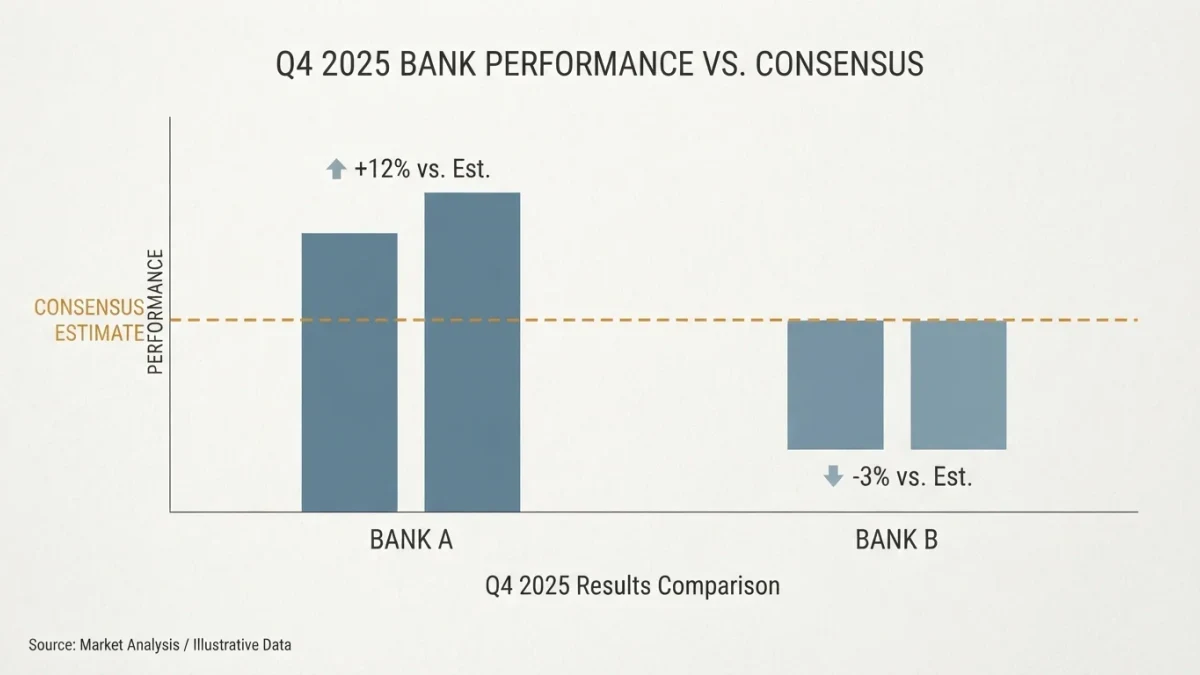
The largest US banks ended a strong 2025 with a divided fourth quarter. JPMorgan Chase reported adjusted earnings of $5.23 per share on January 13, 2026, beating the $5.00 consensus compiled by LSEG, on revenue of $46.77 billion against roughly $46.2 billion expected, per CNBC. Net income absorbed a one-time charge tied to its Apple Card arrangement alongside higher loan-loss provisions. NewsJay publishes information and education, not investment advice, and none of this is a recommendation on any security.
Citigroup, reporting January 14, 2026, showed the other side of the quarter: markets revenue fell about 1.3% versus a year earlier, lagging rivals that posted trading gains, while its investment banking results held up better, per company disclosures and trade-press tallies. The split capped what analysts had called a banner year for the industry, with trading income a key driver and investor attention fixed on 2026 growth guidance, per S&P Global's pre-earnings survey.
What the quarter says about the industry
Three threads ran through the reports. Payments and card businesses kept compounding — J.P. Morgan Payments posted $5.1 billion in quarterly revenue, up 9% year over year, per the company. Credit costs crept higher across lenders, visible in the larger provisions. And franchise scale increasingly decided outcomes: institutions with big markets and payments engines absorbed softer spots, while narrower franchises showed them.
What a long-term playbook does with this
For investors who own banks only through index funds, the quarter is context, not a trigger: bank profitability feeds dividends and buybacks inside broad indexes, and one quarter's trading miss or one-time charge does not alter a decades-long allocation. The evidence-based response is to note what the results confirm — earnings season has begun, provisions are rising industry-wide — and to leave the reacting to traders. Aggregate industry data will arrive with the FDIC's Quarterly Banking Profile in coming weeks.
FAQ
Did big banks have a good 2025?
By the pre-earnings analyst framing, yes — 2025 was described repeatedly as a banner year for large US banks, led by trading income. The fourth quarter's split results closed the year rather than changing its shape.
Why did Citigroup's trading lag?
Citi's markets revenue slipped about 1.3% year over year while major rivals posted gains in the same quarter, per trade-press comparisons. Firm-specific positioning and client activity, not market conditions alone, drove the gap.