
SIPC protection covers up to $500,000 per customer at a failed brokerage, of which $250,000 can be cash, and it exists to return missing securities when a firm collapses — not to insure investment losses. The figure and the limits come directly from the Securities Investor Protection Act and the Securities Investor Protection Corporation's own disclosures. NewsJay publishes information and education, not investment advice, and readers with large balances should verify their own coverage directly with their brokerage.
What problem was SIPC created to solve?
Congress created the corporation in 1970 after a wave of brokerage failures left customers of otherwise solvent firms unable to get their shares back. The paperwork of ownership sat inside firms that no longer operated. SIPC's mechanism addresses exactly that failure mode: when a member brokerage fails, SIPC supervises the transfer or liquidation and steps in to replace missing customer property up to the statutory cap. Membership is mandatory for US broker-dealers registered with the Securities and Exchange Commission, funded by assessments on members rather than taxpayer money.
What exactly is covered?
Covered property includes stocks, bonds, mutual fund and ETF shares, and cash held for the purchase of securities or from sales. The $500,000 limit applies per customer in each separate capacity — an individual account, an IRA, and a joint account are generally counted as separate capacities, a distinction that matters for households structuring balances. Coverage follows the custodial failure, not the asset's price: if the shares exist, they are returned even if the market has fallen.
What is not covered?
The exclusions are where misunderstandings get expensive. SIPC does not cover losses from market movement, poor advice, fraud that leaves the securities intact, or commodities and futures contracts. It does not protect crypto assets held in a crypto-only venue, a boundary the corporation states plainly amid expanding digital-asset offerings. The table separates the two worlds.
| Situation at a failed brokerage | SIPC response |
|---|---|
| Shares and fund units are missing | Replaced up to $500,000 per capacity |
| Cash awaiting reinvestment is missing | Replaced up to $250,000 of the $500,000 |
| Portfolio fell because markets fell | Not covered — the securities still exist |
| Crypto tokens held at the firm | Not covered as SIPC property |
| Bad recommendations by an adviser | Not covered — separate legal remedies apply |
How does SIPC differ from FDIC insurance?
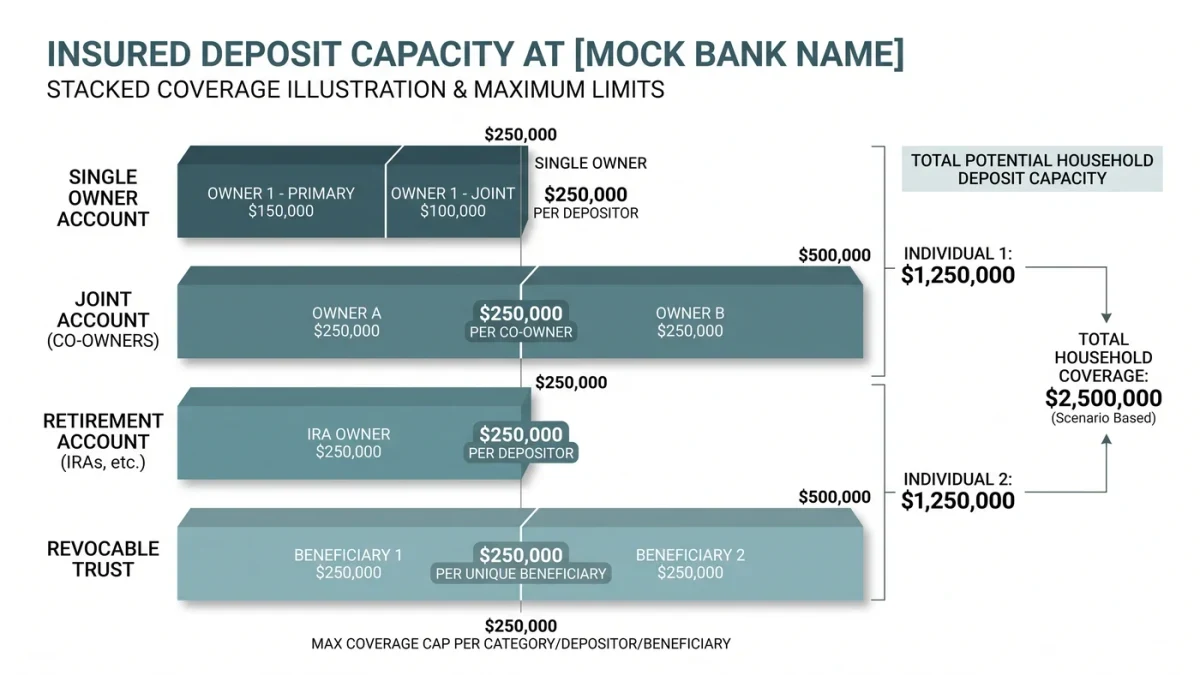
FDIC insurance protects bank deposits — checking, savings, certificates — up to $250,000 per depositor per bank per ownership category, and pays out promptly because deposits have a fixed dollar value. SIPC protects custody of securities whose value changes daily and works through a legal process that can take weeks to months. Cash at a brokerage is SIPC-covered only within the $250,000 cash sublimit, while cash swept to affiliated program banks may carry FDIC coverage instead — a detail worth confirming in account paperwork rather than assuming.
What happened in the failures investors remember?
The two instructive cases run in opposite directions. When Lehman Brothers' brokerage arm failed in 2008, customer securities were largely transferred and returned, and the process worked as designed. When Bernard Madoff's firm collapsed the same year, SIPC advanced funds but the recovery hinged on years of litigation over what customer property even meant. The lesson is not that protection is hollow; it is that protection covers custody failure, and speed of recovery depends on how clean the firm's books are.
How should an investor use this information?
Three checks take minutes: confirm the brokerage is SIPC-member through the corporation's member database, read where uninvested cash actually sits under the account agreement, and consider whether excess-SIPC coverage — private supplemental protection some firms carry — is disclosed and what it excludes. None of this prevents losses from investing; it prevents a firm's collapse from compounding them.
FAQ
Does SIPC cover multiple accounts at the same brokerage?
Partially. Separate capacities — an individual account, a retirement account, a joint account — each generally receive their own $500,000 limit. Two individual accounts in the same name, or multiple accounts in one capacity, are aggregated together under a single limit.
Are ETFs and mutual funds covered?
Yes — fund shares and ETF shares are securities for SIPC purposes and are replaced if missing at a failed member firm. The coverage concerns custody, not the funds' market value, which can still fall to zero in a failure of the underlying investments.
Is crypto covered if my brokerage offers it?
Generally no. SIPC has stated that crypto assets are not SIPC property. Some firms hold token products through separate entities; the account agreement, not the marketing page, is the controlling document.
How fast are customers made whole?
When records are clean, transfers to another broker can complete within weeks. Contested or fraudulent books extend the timeline into months or years, which is why the quality of the firm matters alongside the existence of the protection.