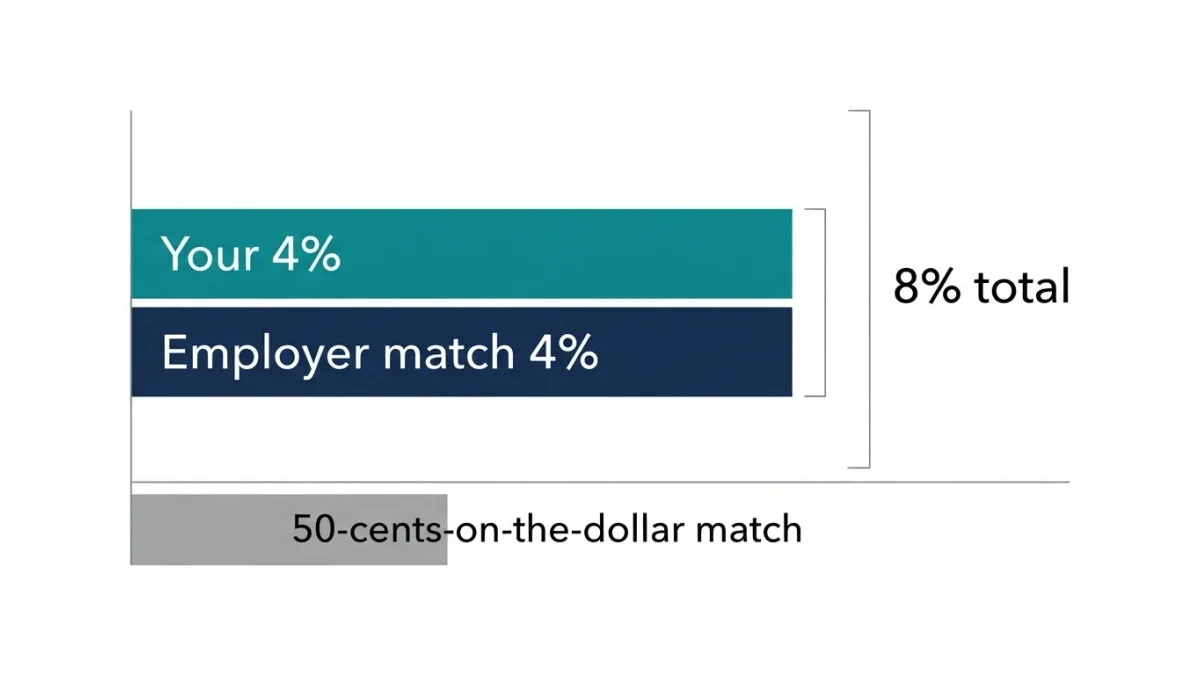
A 401(k) match is employer money deposited into your retirement account when you contribute — commonly 50 cents or a full dollar per dollar up to a percentage of salary — so a typical 50% match to 6% of pay is an instant 50% return on every matched dollar, before any market return. The 2026 employee deferral limit is $24,500, per the Internal Revenue Service's cost-of-living adjustments announced in November 2025, with a $8,000 catch-up from age 50. NewsJay publishes information and education, not tax or investment advice.
How do matching formulas actually work?
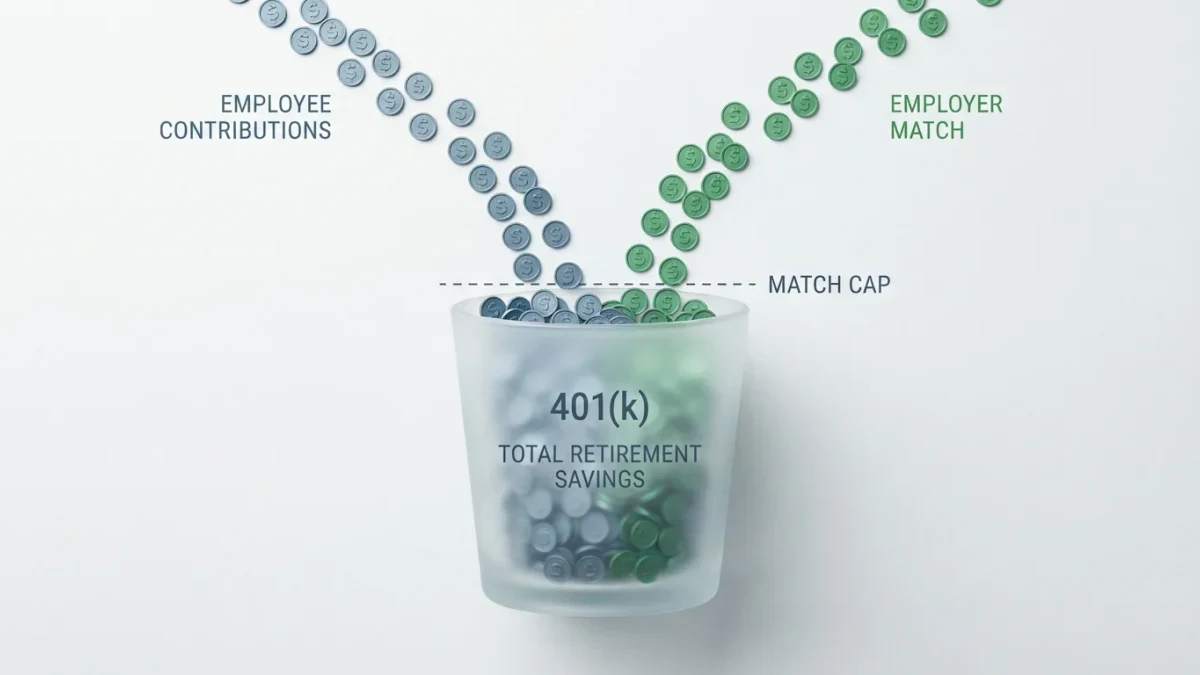
Formulas state a rate and a cap: dollar-for-dollar on the first 4% of pay; 50% on the first 6%; dollar-for-dollar to 3% then 50% to 5%. The cap is the crucial half — an employee contributing 15% to a plan matching only the first 6% receives matching on 6% alone, while an employee contributing 4% to a 6%-cap formula leaves free money unclaimed. The universal arithmetic: contributing exactly to the cap captures the full match; anything below deliberately declines part of compensation already earned.
What is vesting and why does it matter?
Vesting is the schedule on which matched money becomes irrevocably yours. Immediate vesting transfers everything at deposit; graded schedules release shares over years — commonly 20% per year for five; cliff schedules release nothing until a single date, often year three. Your own contributions are always 100% yours from day one. Vesting is the arithmetic behind job-change timing: resigning one month before a cliff date forfeits the entire match, a sum worth checking before any resignation letter.
| Feature | Your contributions | Employer match |
|---|---|---|
| Owned immediately? | Yes, always | Per vesting schedule |
| 2026 annual limit | $24,500 deferral | Combined cap $72,000 |
| Catch-up at 50+ | $8,000 | — |
What did SECURE 2.0 change that matters here?
Three provisions rework the terrain. Automatic enrollment for new plans — most covering plans established after 2022 must enroll new employees between 3% and 10% of pay, escalating annually, with opt-out rights. Long-term part-timers earn eligibility at 500 hours over two consecutive years instead of the old 1,000-hour gate, opening plans to workers the old rules excluded. And catch-up contributions from age 50 continue with new rules phasing in — the Roth-only requirement for high earners was delayed to 2026, a transition workers subject to it should confirm with plan administrators this year.
How should an employee sequence contributions?
The evidence-aligned order is stable. Capture the full match first — no legal investment offers its arithmetic. Then consider a health savings account if eligible, whose triple tax treatment outranks most alternatives. Then return to the 401(k) toward the deferral limit or open an IRA; the traditional-versus-Roth question follows the same rate-comparison logic it always has. High-fee plan menus are the known weakness of the final step — the match's instant return dominates fee drag up to the cap, but dollars beyond it deserve comparison with outside alternatives.
What about employer stock inside the plan?
Some plans match in company shares. Concentration arithmetic applies with special force: the employer pays both the paycheck and the match, so a company setback hits income and portfolio together — the pattern that devastated employees at past corporate collapses. Where shares can be divested, scheduled diversification into plan alternatives is the standard practice, with the plan's rules on timing governing the pace.
How do matching formulas vary across employers?
Formulas range widely in practice: the classic 50% up to 6%, dollar-for-dollar to 4 or 5%, tiered schedules that blend both, and — increasingly — non-elective contributions the employer deposits regardless of what the employee contributes. The variation matters for job comparison: a salary offer with a weaker match is a smaller offer, and total compensation math treats the match as deferred salary, because it is. Two numbers define any formula — the match rate and the cap — and the employee's rule is invariant: contribute at least to the cap, every year, from the first eligible paycheck.
How does the Roth 401k option change contribution choices?
Since 2006, plans may offer designated Roth 401(k) contributions — after-tax deferrals whose qualified withdrawals, including all growth, are tax-free. The match follows the plan's default into traditional pretreatment either way, but the employee's own deferral choice uses the same rate-comparison logic as the IRA decision, with one wrinkle: high earners face the 2026 Roth catch-up requirement — catch-up contributions for those with prior-year wages above $145,000 must be Roth — making the election paperwork a genuine decision point this year rather than a formality. Reading the plan's Roth election materials before the deadline is the new annual chore the law created.
What happens to a 401k at a job change?
Four doors, each with trade-offs: leave it in the old plan — simplest, keeps loan and creditor protections, menu constraints; roll to an IRA — widest investment choice, with the loss of some protections and the rule that IRA rollovers can complicate later backdoor Roth contributions; roll into the new employer's plan — one consolidated account, menu-dependent; cash out — almost always wrong, with taxes and typically a 10% early-withdrawal penalty converting a setback into a permanent one. The match's vesting schedule should be checked before the departure date, not after, and the decision belongs on the checklist of any job negotiation.
What is the one-sentence summary?
Contribute to the match cap from the first paycheck, read the vesting schedule before any resignation letter, and treat the 2026 Roth catch-up rules as this year's one new form to file — the rest of the 401(k)'s value is arithmetic the plan compounds on its own.
How often should you review the plan?
Annually at open enrollment, when fee disclosures, match formulas, and fund menus change together — and after any SECURE-era rule notice, which arrives by mail more often than email.
FAQ
Is a 401k match really free money?
It is deferred compensation you earned — part of your total pay, forfeited if not claimed. The free-money framing undersells it: skipping the match is a pay cut you approve.
Roth 401k or traditional 401k for matched dollars?
The match follows the plan's design into the same pot either way; your choice governs taxation of your deferrals, and the rate-comparison logic is identical to the IRA version — deduct now at a high bracket, or pay now expecting higher later.
What happens to my match when I leave?
Whatever is vested goes with you — rolled to an IRA, a new employer's plan, or stayed put. Unvested amounts return to the plan. Check the vesting schedule before the last day, not after.
Can I contribute beyond the match?
Yes, to the $24,500 deferral limit, and the unmatched dollars still earn tax-deferred growth. The match is the floor of sensible contributing, not the ceiling.