
Asset location decides which holdings sit in taxable, tax-deferred, and Roth accounts — and for an investor with multiple account types, placement is worth a meaningful fraction of a percent a year in after-tax return, at zero cost and zero added risk. The principle: assets taxed most heavily belong in accounts where taxes never touch them; assets the tax code already treats kindly can live anywhere. Published analyses, including Vanguard's, have estimated the benefit at tens of basis points annually for suitably sized portfolios. NewsJay publishes information and education, not tax or investment advice.
What does each account type do to returns?
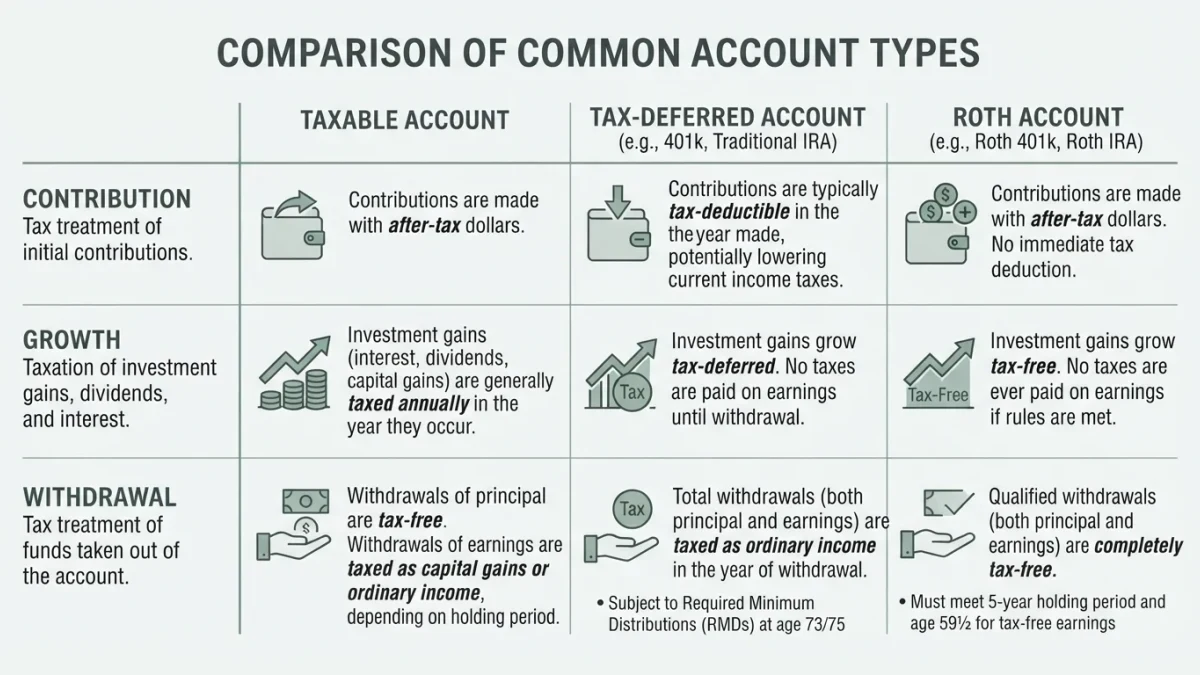
Taxable accounts tax dividends and realized gains annually at preferential rates, with basis step-up at death. Traditional tax-deferred accounts — 401(k)s, traditional IRAs — charge ordinary income rates on everything at withdrawal, converting capital gains into ordinary income. Roth accounts tax nothing ever again: qualified withdrawals are tax-free, making Roth space the most valuable real estate a portfolio has. The location question is which assets to route through which tax treatment.
| Asset class | Tax character | Best-fit account |
|---|---|---|
| Taxable bonds, REITs | Ordinary income | Tax-deferred first |
| Broad stock index funds | Qualified dividends, low turnover | Taxable-friendly |
| High-turnover active funds | Distributed gains | Tax-deferred |
| Highest expected-growth sleeves | Large future gains | Roth |
Why do bonds go in tax-deferred first?
Bond interest is taxed as ordinary income the year it arrives — the harshest treatment available — so sheltering it converts the worst-taxed asset into an untaxed one. A bond fund yielding 5% in a 32% bracket loses 1.6 percentage points a year to taxes in a taxable account; the same fund inside a traditional IRA compounds gross. Index equity, by contrast, already enjoys qualified-dividend rates and near-zero turnover, so its taxable penalty is small — the pair of placements that fixes the worst tax outcome costs nothing in risk.
What belongs in Roth space?
The assets with the highest expected growth, because Roth's value scales with what it shelters: the sleeve expected to compound largest over decades — commonly small-cap or emerging-market equity in a young saver's allocation — delivers the most tax-free dollars by placing the biggest future balance beyond reach. Using Roth for low-yield bonds wastes its unique property on the asset least likely to generate taxable gains anyway.
What are the real-world constraints?
Ideals meet frictions. The 401(k) menu limits choices, so location works within what the plan offers — often fine, since the principle needs only bond and equity index options. Rebalancing across account types is constrained: selling in the 401(k) to buy in taxable requires new cash, so band-based rebalancing happens inside accounts where possible. Required minimum distributions from traditional accounts begin at 73 under current law, a future tax event that location planning should note but not over-engineer. And the order of withdrawals in retirement — traditionally taxable first, Roth last — interacts with placement in ways best kept simple until the accounts are large.
How much does this actually matter?
Scaled honestly: less than saving more, more than fund selection skill. The published estimates put location's value in the tens of basis points a year — over decades, several percentage points of final wealth — with zero risk and usually zero cost. Investors holding one account type gain nothing from the theory; investors with taxable plus retirement accounts gain meaningfully from an afternoon spent placing assets once and re-checking annually.
What is the withdrawal-side logic of location?
Placement decisions made for decades pay off in retirement's withdrawal sequencing: tax-deferred balances fill the low brackets each year, Roth assets stay untouched and compounding, and the taxable account — holding basis and preferential rates — supplies flexible top-ups and, for estates, the step-up that erases unrealized gains entirely. The retiree with all three account types chooses each year which pocket funds spending; the retiree with everything in a 401(k) has no choice, and RMDs arrive as ordinary income whether needed or not. Location, done early, is quietly building that menu of pockets decades before the ordering begins.
How does location interact with fund placement inside a single 401k?
Plan menus rarely offer the full palette, so location works with what exists: bonds are usually available through a stable-value or index option, equities through the S&P 500 fund, and the plan's institutional pricing often undercuts retail equivalents. The refined move for households with multiple accounts is assigning each sleeve to the account with the best available version — the plan's cheap bond fund, an IRA's international index, taxable's tax-managed equity — so the household portfolio holds its intended allocation while each asset sits in its best-fitting wrapper. The spreadsheet that tracks this is the household balance sheet, and it is the one document worth maintaining meticulously.
How does asset location interact with tax-loss harvesting?
Harvesting is a taxable-account activity by definition, so its machinery lives beside the equity sleeve that sits there: losses realized in taxable offset gains anywhere, and the harvested sleeve's replacement fund must not overlap the sale in a way that trips wash-sale windows against automatic reinvestment. Location's contribution to the pairing is keeping the highest-churn, most-harvestable assets where losses are usable at all — another quiet argument for equities in taxable and income assets in the sheltered accounts. The annual calendar accommodates both disciplines in the same sitting, which is how an afternoon's structure stays an afternoon's maintenance.
What are the common placement mistakes?
The two classics: bonds in taxable while a tax-deferred account holds index equity — leaving ordinary-income yield exposed and sheltering the asset least taxed — and REITs in taxable, whose distributions are largely ordinary income and belong behind the shelter almost as strongly. The mirror mistake is filling every Roth with bonds, parking the most valuable wrapper behind the least growth. The fixes cost nothing but an afternoon, and most investors discover they have been paying for placement errors they never chose.
FAQ
Does asset location change my allocation?
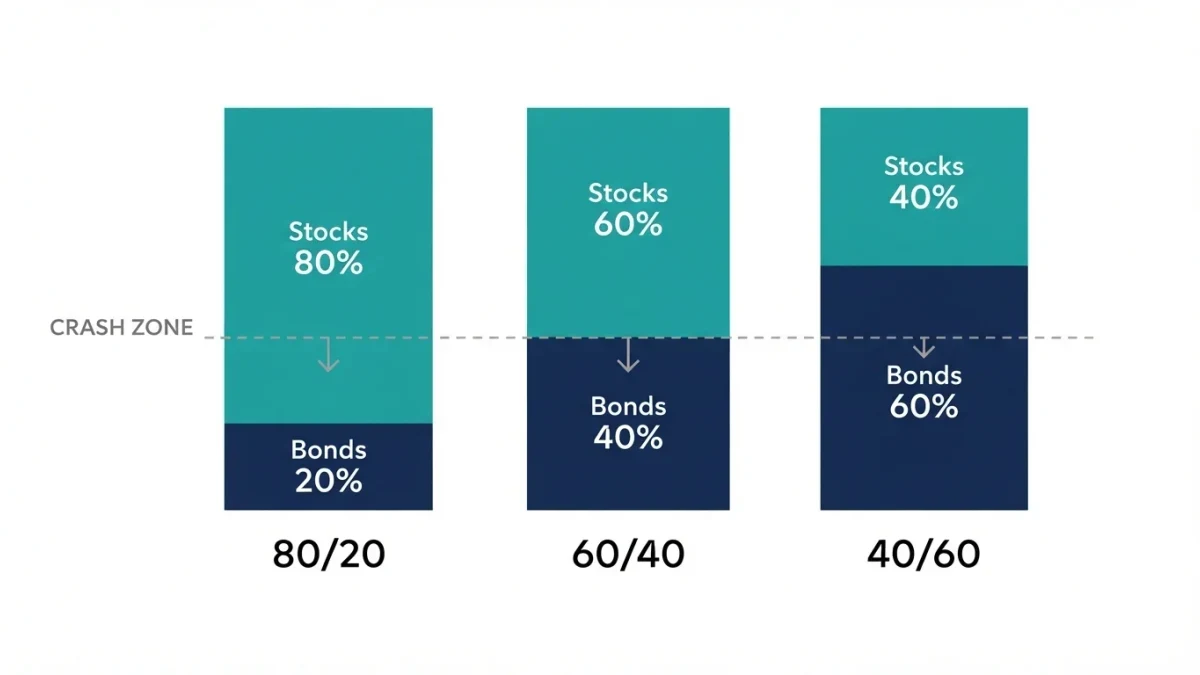
No — the portfolio's overall stock-bond mix stays identical; only the addresses change. Total exposure, risk, and expected pre-tax return are unchanged by construction.
What if my only account is a 401k?
Location does not apply — a single account is its own location. The concept earns its afternoon only once taxable and tax-advantaged accounts coexist.
Should international equity go in taxable?
Commonly yes: foreign withholding taxes on dividends can often be claimed as a credit only in taxable accounts, a small genuine edge that partially offsets the dividend tax drag.
Is asset location worth it near retirement?
Diminished — the compounding runway is shorter and Roth conversions often dominate the remaining tax questions. The optimization pays best started early and left alone.