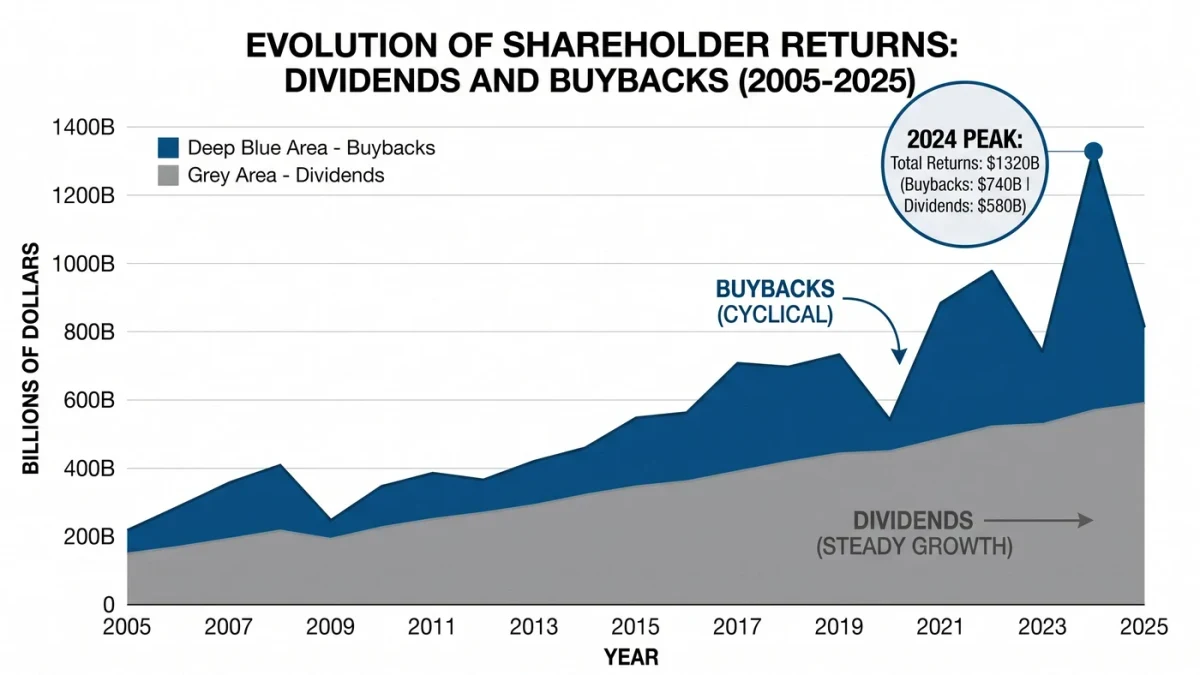

A share buyback returns cash to shareholders indirectly: the company repurchases its own stock, the share count falls, and every remaining share claims a larger fraction of future earnings — US companies have repurchased more than $700 billion of their own stock annually in recent years, per S&P Dow Jones Indices data. The mechanics resemble a dividend reinvested in reverse, executed by the company rather than the investor. Whether it creates value depends entirely on the price paid. NewsJay publishes information and education, not investment advice.
What actually happens in a repurchase?
The board authorizes a dollar amount; the company buys shares in the open market over months or years under Rule 10b-18, the Securities and Exchange Commission safe harbor that sets price, volume, and timing conditions meant to prevent manipulation. Repurchased shares are usually retired or held as treasury stock — either way they no longer count in per-share figures. Announcements are ceilings, not promises: authorization programs historically go partially unexecuted, especially in downturns, exactly when executing would be most attractive.
How does the arithmetic reach shareholders?
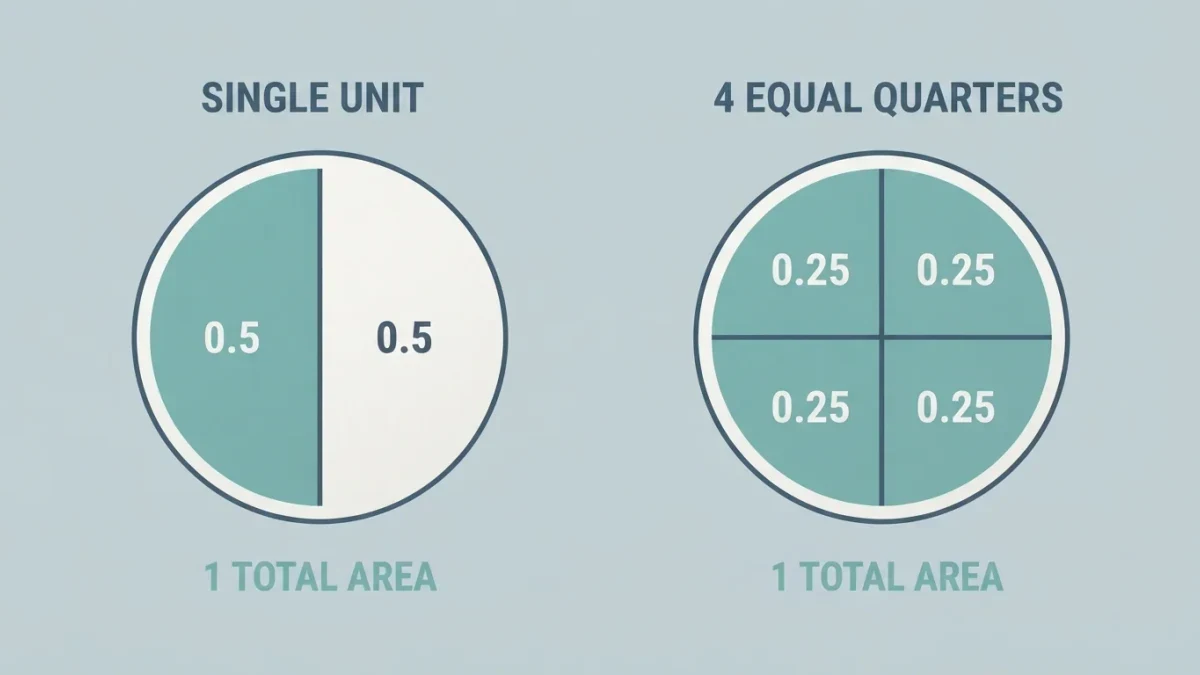
Through the denominator. Suppose a hypothetical company earns $1 billion and has 400 million shares — earnings per share of $2.50. Retiring 40 million shares lifts EPS to about $2.78 on unchanged earnings, and each remaining share's claim on dividends and assets rises by the same proportion. No new profit was created; the ownership was concentrated onto fewer claims. When buybacks are funded from free cash flow at prices below intrinsic value, remaining shareholders genuinely gain. When funded with debt at cycle-top prices, the per-share figures rise while the business weakens — enrichment by leverage.
| Hypothetical | Before buyback | After retiring 10% |
|---|---|---|
| Shares outstanding | 400 million | 360 million |
| Earnings | $1.0 billion | $1.0 billion |
| Earnings per share | $2.50 | $2.78 |
Buybacks versus dividends
Both pay out the same free cash flow, but they differ in commitment and tax mechanics. Dividends are quasi-contractual expectations — cutting one carries a visible penalty — while buybacks flex with circumstances, which is precisely why managements prefer them and income investors cannot rely on them. Dividends are taxed to all recipients when paid; buybacks create no immediate tax, with the shareholder's gain arriving later as capital gain at sale — the tax treatment debate that resurfaces in every Congress.
What are the honest criticisms?
Three carry evidence. Management compensation tied to EPS gives executives a private incentive to buy back shares at any price — the metric rises even when value does not. Companies have historically repurchased most aggressively near market peaks and quietly stopped in crashes, buying high as institutions and selling to no one low. And money spent on repurchases is money not spent on R&D or capacity — occasionally the right trade, sometimes the surrender of durable advantage for a quarterly optics gain. None of this indicts buybacks as a tool; it indicts evaluating them by announcement size rather than execution price and funding source.
How should an investor judge a company's buyback?
Read the buyback disclosure in the 10-K — shares repurchased, average price, and remaining authorization — beside the share count trend across five years. The questions are three: was the repurchase funded from free cash flow or borrowing; was the average price paid below or above the range the stock subsequently traded in; and did total shares actually fall, or did option issuance and mergers refill the count while the headline celebrated repurchases? Companies quietly reporting net share count growth during buyback years are answering the third question against themselves.
How should buybacks be read in earnings season?
The quarterly cycle delivers the raw material: cash flow statements show repurchase dollars, the 10-Q's cover page tabulates shares bought and average prices, and earnings calls frame the pace. The disciplined read holds three numbers together — free cash flow, buyback dollars, and dividends — asking whether payouts fit inside cash generation with room for the capital spending the business needs. Repurchases exceeding free cash flow, funded by debt issuance in a strong economy, mark the pattern that deserves skepticism; steady repurchases inside comfortable coverage mark the pattern the evidence treats kindly. The season's noise is announcement size; the signal is funding source and price.
What did the research find about repurchase timing?
The timing studies are unflattering in aggregate: firms have historically repurchased more when prices were high and pulled back in crashes, buying expensively relative to the subsequent decade's average — behavior consistent with compensation-linked incentives and cash-cycle mechanics rather than value discipline. Individual companies differ, and a minority with consistent through-cycle programs outperform the pattern. The investor's usable version is checking a specific company's own record: average prices paid versus the range traded since, visible in five years of filings, answers the timing question for the one company that matters to the holder.
How do buybacks interact with index construction?
Repurchases feed back into the indexes themselves: a company buying back shares sees its float shrink, and cap-weighted indexes adjust weights accordingly through their regular rebalances — index holders neither participate nor opt out, but the reduced share count raises earnings per remaining share, which the market prices over time. The effect is one channel by which corporate payout policy reaches even the most passive portfolio, invisible by design and honest in arithmetic. For investors holding factor funds, buybacks also nudge value and momentum signals — the share-count change flows into the ratios screens read — another quiet way one company's treasury decision ripples through systematic portfolios.
What is the shareholder yield view?
Some analysts price the whole payout through shareholder yield — dividends plus net buybacks divided by market value — which captures what the strategy-minded reader wants: the total cash returned, net of shares issued to management. A company returning 4% through shareholder yield is paying out regardless of the label it uses, and the metric reads both honest repurchases and disguised option offsets honestly. It is a lens, not a verdict — execution price still decides value — but it ends the vocabulary dispute about which payout counts.
FAQ
Do buybacks mechanically raise the stock price?
Not mechanically. The share count falls and per-share fundamentals rise, but the price responds to value perception — a buyback at excessive prices can destroy remaining-shareholder value even as EPS improves.
Why do buybacks get political criticism?
Because they are visible, large, and flexibly timed, and because critics argue capital returned to shareholders is capital not invested in wages or capacity. The economic evidence on investment substitution is mixed; the optics argument is not.
Is a buyback announcement good news?
Mildly, at most. It signals management's view that cash exceeds investment opportunities and that shares are not obviously overpriced. Announcements often function as soft price floors; the value is decided by execution, not authorization.
Do index investors participate in buybacks?
They benefit automatically — funds do not tender shares, but the falling share count raises the index weight of the business's earnings per remaining share, and broad indexes weight by market capitalization throughout.