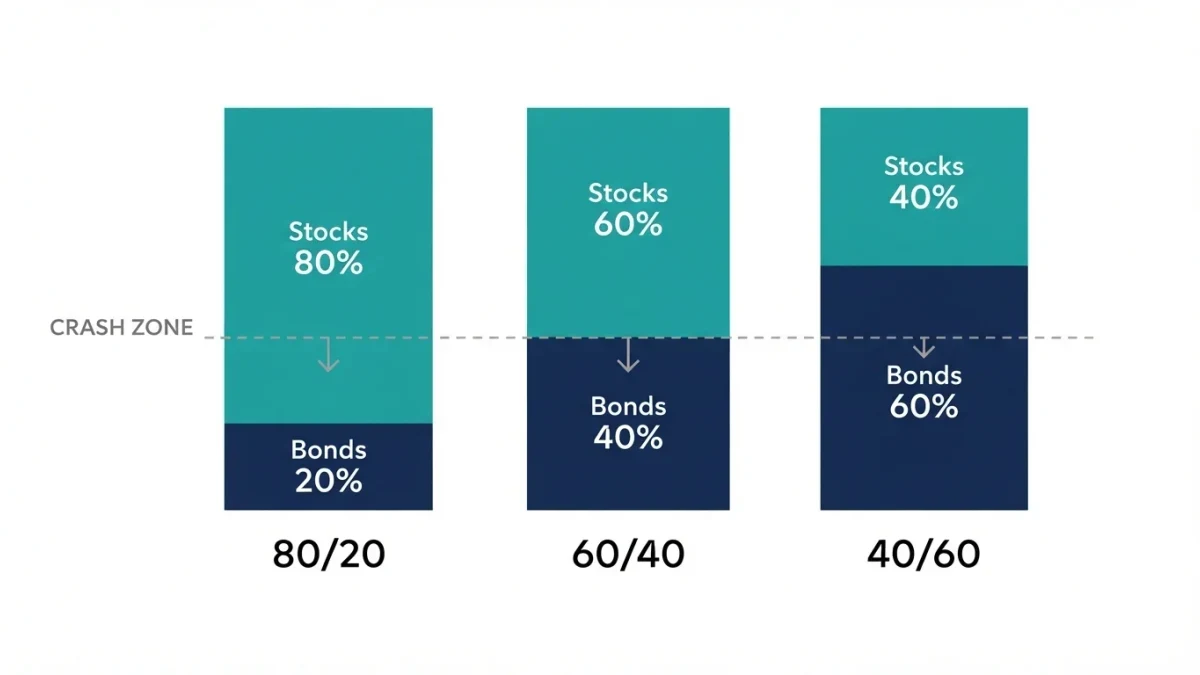
The classic guideline — stocks at 110 or 100 minus your age, so a 30-year-old holds roughly 80% — encodes a real truth: allocation should de-risk as the portfolio's job shifts from accumulating to spending. But it is a rule of thumb, not a rule: two 65-year-olds with identical savings, one still working and one retiring into a 30-year withdrawal horizon, need genuinely different portfolios. Age proxies for horizon and human capital, and it is those two quantities allocation actually responds to. NewsJay publishes information and education, not investment advice.
Why does allocation shift with age at all?
Two forces. Compounding arithmetic: a portfolio that must fund thirty years of withdrawals can ill afford a sequence of bad early-retirement years, so the cost of equity risk rises precisely when the balance peaks — the sequence-of-returns problem. Human capital: a salary is bond-like, paying steady income decades forward, so a young worker's total wealth is mostly human and the financial portfolio can carry equity risk; at retirement the salary stops, total wealth becomes fully financial, and the same equity exposure becomes riskier without changing at all.
What does the age-based ladder look like?
The bands are wide because circumstances vary more than birthdays.
| Life stage | Typical equity range | What drives it |
|---|---|---|
| 20s-30s | 80-100% | Human capital dominant; long horizon absorbs crashes |
| 40s-50s | 60-80% | Peak earnings; balance between growth and protection |
| Early retirement | 50-70% | Sequence risk governs the first decade |
| Late retirement | 40-60% | Spending horizon shortens, but inflation never retires |
The nonlinearity matters: even late retirement keeps meaningful equity, because a 65-year-old couple's joint life expectancy pushes the planning horizon past two decades, and purchasing power must survive it. Portfolios that de-risk to near-cash at 65 are betting against longevity.
What matters more than the number?
Three things. The withdrawal rate the portfolio must support — the higher the required spending rate, the more the sequencing of returns dominates everything else. The stability of remaining income — pensions, Social Security, and part-time work function as bonds inside the household balance sheet and argue for more equity in the portfolio proper. And behavioral capacity — the allocation an investor will actually hold through a 2022-style year, which is the only allocation that ever pays its expected return.
How do target-date funds handle this?
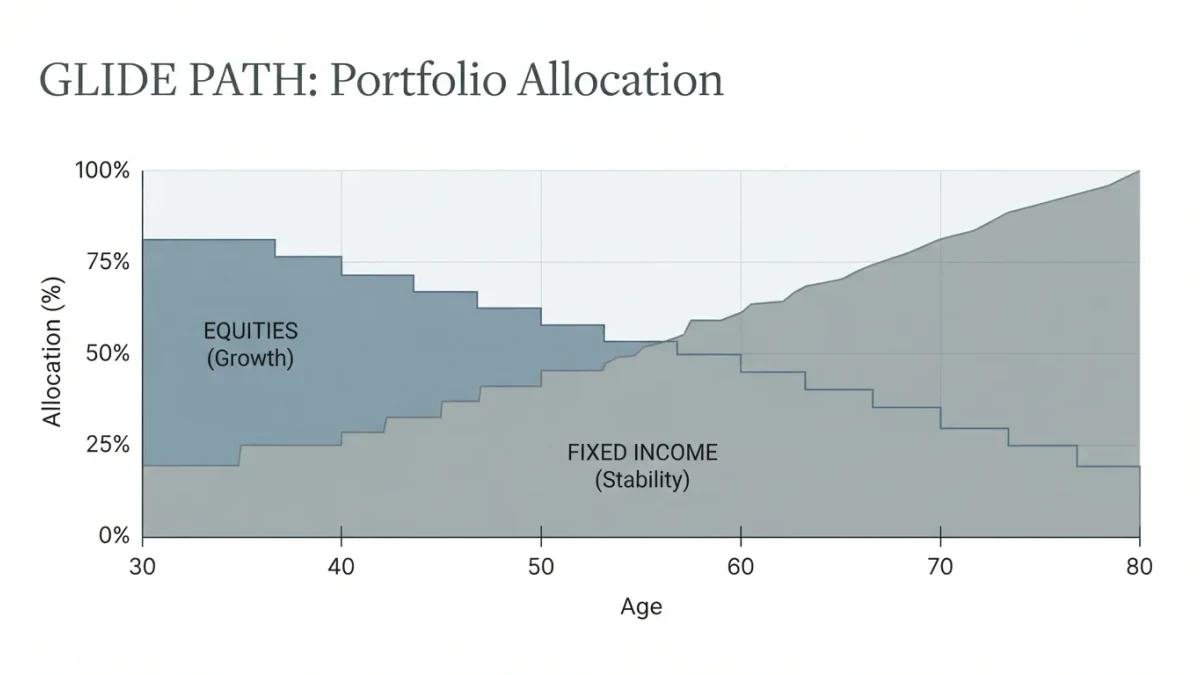
They implement the ladder automatically through a glide path, stepping equity down on a schedule keyed to a retirement year, with the decline slowing rather than stopping in retirement under most current designs. Their virtue is removing the investor's discretion at exactly the moments discretion fails; their limitation is knowing nothing about your pension, your spending, or your stomach. A target-date fund at the right retirement date is a defensible default; it is not a personalized plan.
When should the rule be ignored?
Whenever age is the least informative fact available. An inheritance arriving at 35 to fund a house purchase in three years is bond money regardless of youth; a healthy 70-year-old with a pension covering all spending can run equity-heavy portfolios for heirs. The discipline is writing down what each dollar is for and when — goals-based buckets — and letting those horizons, not the birthday, set the mix.
How do pensions and Social Security change the age rule?
Guaranteed income functions as a bond the household already owns: a pension and Social Security covering core expenses reduce what the portfolio must safely deliver, freeing the financial assets to carry more equity than the birthday formula suggests. The framing is the household balance sheet — human capital and guaranteed income on one side, financial assets on the other — with allocation set for the financial slice alone. Retirees with generous fixed incomes routinely run 70% equity portfolios responsibly; savers with neither pension nor stable income may need bond weight in their thirties. The age rule never sees any of this, which is why it starts rather than ends the conversation.
How does the spending side of retirement change allocation?
The withdrawal rate sets the constraint: portfolios supporting withdrawals near 4% of principal carry a well-documented tension between sequence risk and longevity risk that allocation threads with a barbell — several years of spending in cash and short bonds, growth assets for the decades after, and the middle durations bridging. Portfolios supplementing lifestyle rather than funding it can carry simpler, growth-tilted allocations. The number that matters is the household's: what fraction of spending the portfolio must produce, and for how many years — inputs no age formula contains.
How often should the age-based allocation actually change?
Gliding, not stepping: the honest schedule changes allocation a few points every several years, with annual reviews confirming the drift direction rather than debating it. The changes that justify real jumps are events — a pension begins, a mortgage ends, a health reality revises the horizon — not birthdays. Investors who discover at annual review that no number has moved in five years have usually not been negligent; they have been holding an allocation their life still fits, which is the quiet mark of a plan built on the right variables.
What role does debt play in allocation by age?
Household debt enters the balance sheet as negative bonds: a mortgage at 6% is a guaranteed 6% loss until repaid, and retiring it is a riskless return no portfolio offers. The young saver carrying moderate-rate debt allocates between three assets — equities, bonds, and principal repayment — with repayment taking the bond sleeve's place when its rate exceeds bond yields. The refinancing question of 2020-2023, when locked rates moved below new yields, reversed the math and the answer with it: allocation by age is really allocation by circumstances, and money's cost is one of them.
FAQ
Is 100 minus age or 110 minus age right?
Neither is right; both are starting points. The 110 variant reflects longer retirements than the older 100 rule assumed. The honest range between them is noise compared with the differences made by spending rates, income stability, and behavior.
Should I be 100% stocks while young?
Arithmetically defensible over very long horizons and psychologically survivable only for some. The cost of the discipline is watching a 2008-scale halving with decades still to invest — which many young investors in 2008 did not sustain. Choose the maximum drawdown you will not sell through, and set allocation there.
How fast should I de-risk approaching retirement?
Gradually, on a written schedule — the decade around the retirement date carries the highest sequence risk, and stepwise adjustment through that window is the standard practice. One-day reallocations in response to headlines are how sequence risk is realized, not managed.
Do I need to adjust every birthday?
No — annual review with changes in five-point steps is plenty. Allocation drift from markets usually moves faster than allocation targets from birthdays; rebalancing handles the first, the calendar the second.