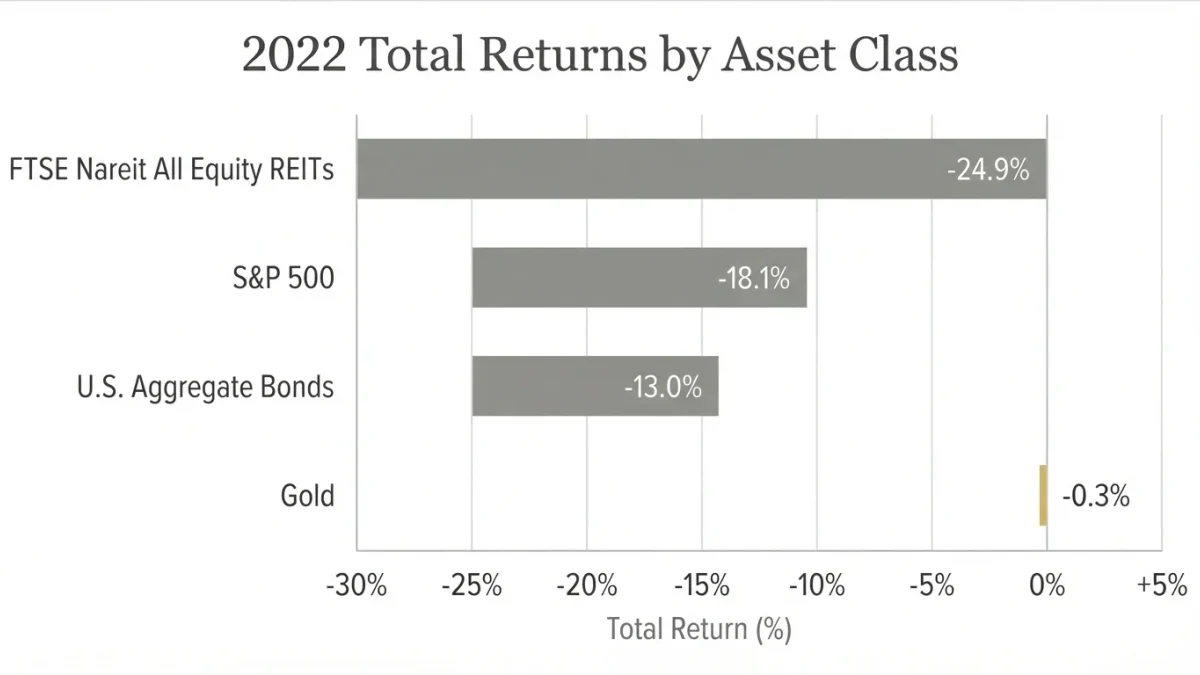

A 60/40 portfolio puts roughly 60% of assets in diversified stocks and 40% in investment-grade bonds, rebalanced back to those weights over time. In 2022 it suffered one of its worst years on record — US stocks fell about 18% and the core US bond index about 13%, per index total-return data — and that stress test, not any marketing, explains what the construction does and when it fails. NewsJay publishes information and education, not investment advice, and past performance never guarantees future results.
What does each sleeve actually do?
The equity sleeve supplies growth: over long historical periods, broad stock ownership has compounded at roughly 7% a year after inflation across US records since 1926, per the Stocks, Bonds, Bills, and Inflation data series — with the ride including multiple drawdowns past 30%. The bond sleeve supplies ballast and income: high-quality bonds hold principal value when growth scares equity markets, because recession fears push rates down and bond prices up. The two sleeves fail together almost only in inflation shocks, when rates rise and punish both at once — exactly the 2022 signature.
What did 2022 actually demonstrate?
Two lessons, often confused. First: 60/40 is not a guarantee — the worst simultaneous stock-bond year in four decades delivered a double-digit portfolio loss, and commentators wrote the obituary again as they had in every decade prior. Second, the following two years demonstrated the recovery mechanic: bonds paid their highest income in years at the new rate levels, and rebalancing at the lows bought equities that subsequently recovered, per index records for 2023-2024. The construction failed at hiding from inflation; it worked at what it was built for — surviving and compounding through cycles.
| Year | US stocks | Core bonds | What it showed |
|---|---|---|---|
| 2008 | −37% | +5% | Bonds as ballast |
| 2022 | −18% | −13% | Inflation shock hits both |
| 2023-2024 | Strong recovery | Stabilizing income | Rebalancing at the lows pays |
Why does such a simple split endure?
Because its virtues are behavioral as much as statistical. A two-fund portfolio can be understood, rebalanced, and tax-managed by one person in an hour a year; complexity is the enemy of persistence. The allocation also matches a truth about risk: most long-horizon investors need growth they will not sell in a crash, and most cannot emotionally hold 100% equities through a 50% drawdown. Sixty-forty is a compromise between arithmetic and psychology that a majority of retirement savers can actually live with.
Is 60/40 obsolete after the 2020s?
The obituary has been written in every decade since the 1970s, and the recurring critique contains a real point: with starting bond yields higher after 2022 than during the zero-rate era, the sleeve's expected return improved materially — yields are the best forward predictor bond research has — while the critique that bonds no longer hedge ignores that the 2022 shock came after four decades of falling rates that made the hedge look better than it structurally was. Investors wanting stronger inflation diversification can add TIPS or modest real-asset exposure; the core construction remains a defensible default rather than a relic.
How is one actually built and maintained?
Simply: a total-market or S&P 500 index fund for the 60, a total-bond-market or aggregate index fund for the 40, rebalanced annually or on 5% drift bands. Variants adjust the split by risk tolerance and horizon — 80/20 for long horizons and strong stomachs, 50/50 or 40/60 near and in retirement. The exact number matters far less than choosing one deliberately and honoring it through at least one full cycle.
How has the 60/40 evolved in practice?
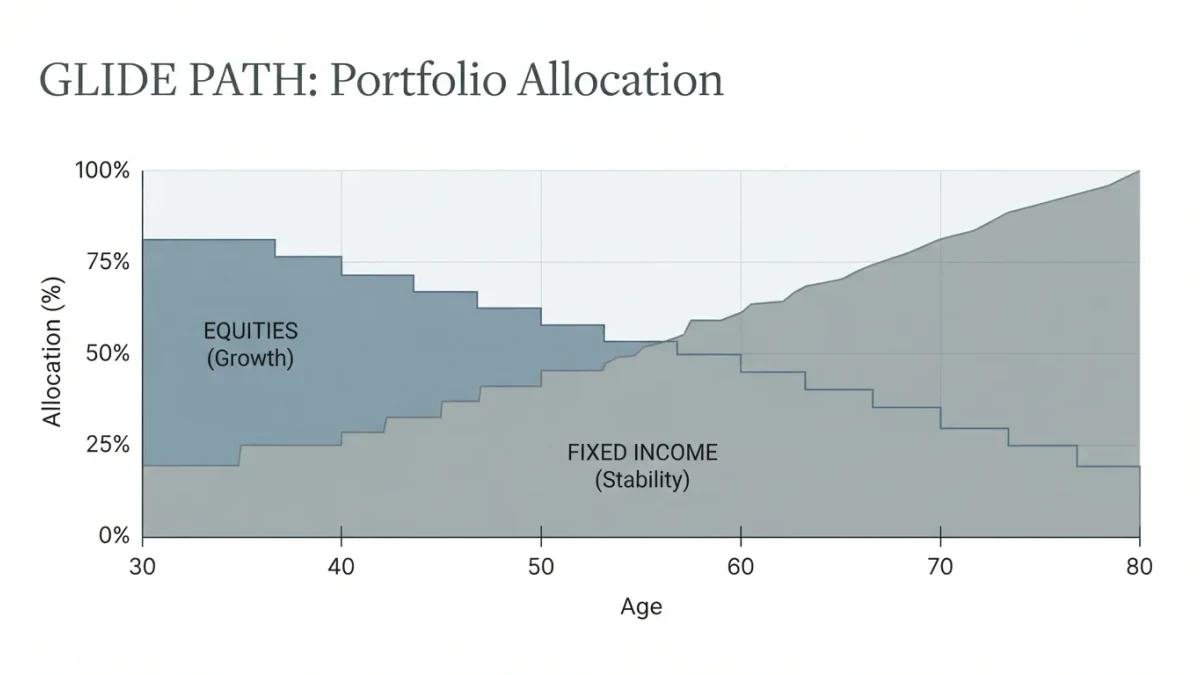
Modern implementations refine the classic without abandoning it: international equity inside the stock sleeve, inflation-protected securities inside the bond sleeve, and for some investors small allocations to real assets — refinements that address 2022's lesson rather than replace the construction. The target-date fund industry's version runs the same architecture on a declining glide path, which is 60/40's logic applied to age. What has not changed is the spine: broad equity for growth, high-grade bonds for ballast, a fixed ratio, and a rebalancing rule. The variants are arguments about the sleeves; the architecture has survived every obituary.
What returns should a 60/40 investor reasonably expect?
History offers a range, not a promise: the blend's long-run nominal record across recent decades runs in the mid-to-high single digits, with its worst calendar years around negative 18% and its best near 30%, per blended index records. The forward-looking building blocks are observable — bond yields at purchase, equity earnings yields — and both were more generous after 2022's reset than during the zero-rate decade. The honest expectation-setting uses those two inputs, states them as of a date, and revises when the inputs move, which is the discipline the construction itself models with its rebalancing rule.
How does a 60/40 investor handle the bond sleeve's income today?
After 2022's reset, the sleeve pays income that matters again: intermediate yields above the inflation of most years past mean the 40% is contributing real return rather than decoration, and the classic arithmetic — bonds' income plus equities' growth — functions as printed. Income-focused retirees can now meet meaningful spending from coupons alone, reducing the need to sell anything in ordinary years. The improvement is not a promise — yields move, and the prices paid for it were the losses of the transition — but it marks the difference between holding bonds as a habit and holding them as a paying position.
FAQ
Is 60/40 enough diversification?
Across asset classes, it covers the two that matter most — public equity and high-grade credit. Adding international equity inside the stock sleeve is a common refinement; exotic diversifiers add complexity that must justify itself. Breadth within each sleeve is what the index funds supply automatically.
Why not 100% stocks if my horizon is decades?
Arithmetically that raises expected return — and the size of every drawdown along the way. The bond sleeve's job is keeping the investor invested; an allocation abandoned in a crash forfeits the equity premium it was built to capture.
Do bond funds lose money when rates rise?
Yes, in price terms — 2022 showed it at scale. But the loss is bounded by duration and partially self-healing: coupons reinvest at higher yields, pulling returns up over the holding period. Holding to fund duration is the mechanism, unlike individual bonds' maturity.
Should the 40 include cash?
A separate emergency reserve outside the portfolio covers spending shocks; inside the 40, cash and short bonds are a volatility choice that lowers both risk and return. Income needs near term — a year or two of planned withdrawals — are the standard reason to hold some short-duration assets.