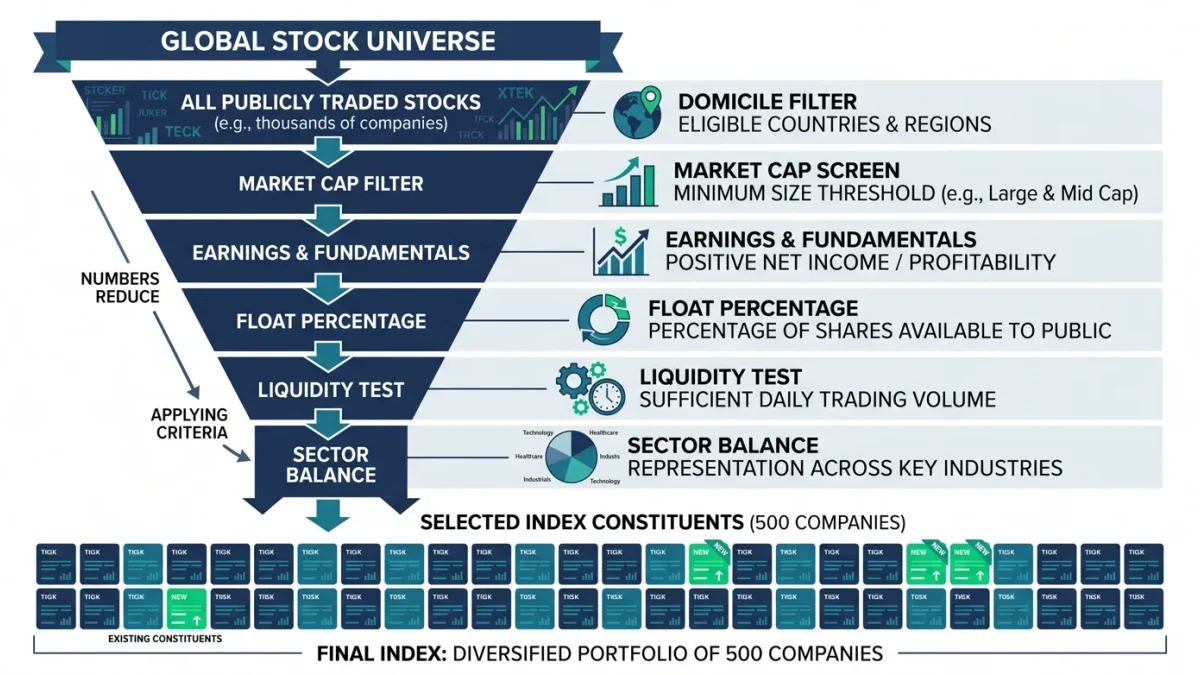

A portfolio of roughly 20 to 30 stocks, spread across industries, captures most of the diversification that single-stock risk allows, according to studies running from Evans and Archer in 1968 through Statman in 1987. Yet research by Hendrik Bessembinder of Arizona State University, first published in 2017, found that just 4% of listed US companies generated all of the stock market's net wealth creation above Treasury bills — a strong argument that a total-market index fund does the job more reliably than any hand-picked thirty. NewsJay publishes information and education, not investment advice, and neither study tells any reader what to own.
What did the classic diversification studies find?
The foundational papers measured what happens as identical portfolios add randomly selected stocks. Volatility from company-specific events falls steeply as holdings rise from one to about ten names, keeps improving with diminishing effect through the twenties, and flattens near thirty, where what remains is market risk itself — the swings no number of additional stocks can remove. Those results, taught for half a century, set the working rule that a two-dozen-stock portfolio of unrelated businesses is meaningfully diversified. The rule survives, but it describes the average outcome, and averages hide the problem.
Why do average returns mislead stock pickers?
Individual stock returns are heavily skewed: a handful of enormous long-term winners pay for a large population of mediocre and negative outcomes. Bessembinder's 2017 study, covering common stocks from 1926 through 2016, found that less than half of all listed stocks outperformed one-month Treasury bills over their lifetimes, because the market's aggregate gain traces to a small superstar cohort. A 2020 JP Morgan asset management analysis of Russell 3000 constituents from 1980 to 2020 reached the same shape of conclusion from a different angle: roughly two-thirds of individual stocks underperformed the index itself, and about 40% suffered severe, permanent losses. For a portfolio of thirty names, that skew means the outcome depends heavily on whether the few future superstars happen to be in it.
How does holding count change risk in practice?
The table summarizes the trade-off in plain terms, using the behavior documented by the studies rather than any single year's data.
| Holdings | Company-specific risk | Realistic worst-case event |
|---|---|---|
| 1-5 stocks | Dominant; one bankruptcy matters | Single failure can halve the portfolio |
| 20-30 stocks | Mostly dampened | One failure costs a few percent |
| Total-market index | Minimal per-name exposure | Only broad market declines remain |
Does adding stocks beyond thirty accomplish anything?
Beyond roughly thirty names, measured volatility reduction becomes negligible while the workload of tracking each business keeps growing. The remaining risk is market risk, which no additional stock count addresses — it is the risk the investor accepted by owning equities at all, and the risk that carries the long-run equity return. Investors who want less of it adjust the split between stocks and bonds rather than the number of tickers.
When does concentration make sense?
Concentration is a deliberate bet that the investor's information about a small set of businesses is better than the market's — a bet professionals with research budgets make cautiously. For most individuals saving in tax-advantaged accounts over decades, the honest assessment is that the effort of maintaining thirty individual positions buys roughly the same average as an index with a far narrower range of outcomes. Some investors hold a core index position and a small satellite sleeve of individual names; that construction keeps the skewness problem contained while leaving room for engagement with individual businesses.
What should investors take from the skewness evidence?
The practical conclusion is about error tolerance. If a portfolio's plan requires avoiding the worst 40% of outcomes, diversification is not a style choice but the mechanism that makes the plan survivable. The total-market fund is the simplest expression of that mechanism: it guarantees the holder participates in every future superstar, at the cost of also holding every future casualty. Owning the market's return, net of a low fee, is what the arithmetic favors.
How does diversification work through funds rather than names?
The modern retail portfolio achieves its holding count through wrappers: one total-market fund contains the entire distribution, and a second international fund extends it across borders. The count question transforms into a weighting question — the fund's cap-weighted construction concentrates in its largest names, so the top ten companies reach a weight no hand-picked thirty-stock portfolio would casually accept. The investor deciding between thirty names and one fund is therefore choosing between two different shapes of concentration: name-specific risk in the first, mega-cap exposure in the second. Understanding that neither shape is risk-free is the point at which the count question becomes an allocation question.
What is the practical middle path?
Many serious amateurs settle on the core-satellite structure: a broad index core holding most of the portfolio, and a satellite sleeve — individual names, sector views, factor tilts — sized so its total loss would bruise but not wound. The construction honors both halves of the evidence: the core guarantees participation in the market's skewness-driven return, the satellite gives engagement and learning their place, and the sizing rule keeps every lesson affordable. The same architecture answers the count question at every account size: the core is always thousands of names, and the satellites are however many the investor can genuinely follow.
What does concentration look like from inside a cap-weighted fund?
The skewness lesson scales up to the index itself: recent market leadership by a handful of mega-caps means broad funds hold their largest names at weights that would look like deliberate bets in any other context, and the top-heavy decades rewarded that concentration while it lasted. The investor uncomfortable with the exposure has options — equal-weight constructions, completion with smaller-cap funds — each trading one known concentration for another. The point of the skewness evidence is not that any particular shape is wrong, but that every shape is a bet someone should be able to state out loud.
FAQ
Is 30 stocks enough diversification?
By the classic volatility studies, yes — company-specific swings are mostly dampened by around thirty unrelated names. The newer evidence on return skewness shifts the question: an index fund holds the superstars no one can identify in advance, which is why many long-term investors prefer it to any fixed count.
Do the same numbers apply to funds?
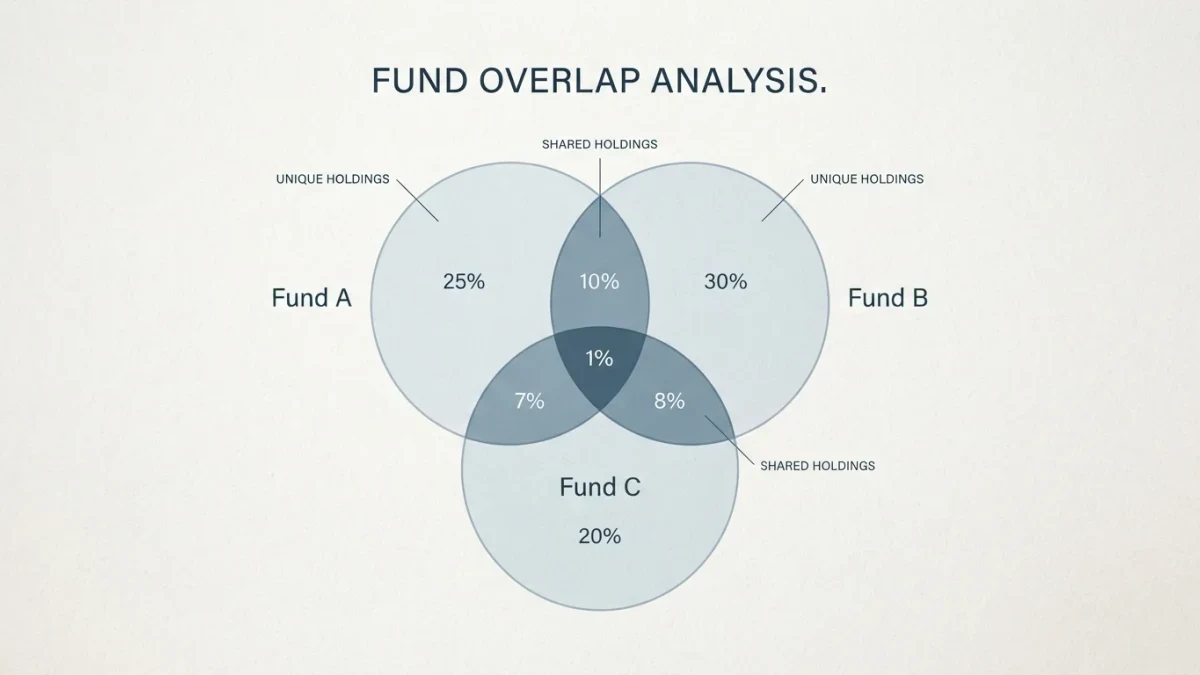
A broad index fund already contains hundreds or thousands of stocks, so the count question is solved inside the wrapper. What remains is overlap between funds — two funds holding the same mega-caps concentrate rather than diversify. Overlap, not count, is the fund investor's checklist item.
What about diversifying across sectors instead of names?
Sector spread matters because same-industry stocks fail together. Thirty names from one industry are barely diversified; the same thirty spread across unrelated sectors are. A total-market fund handles sector spread automatically by market weight.
Does diversification protect me in a crash?
No. Diversification removes the risk of single companies; it does not remove market risk. In broad selloffs, diversified portfolios fall too — that decline is the price of the long-run equity return, and the reason allocation between stocks and safer assets exists.