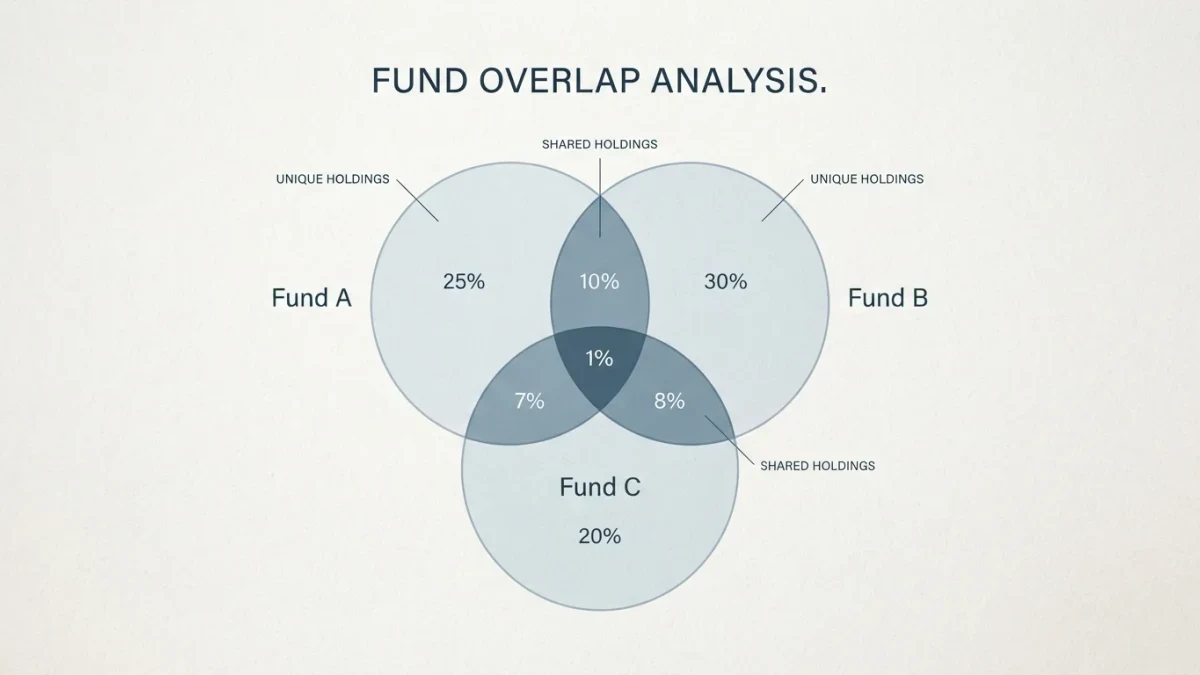
Checking for overlap means asking one question across the whole portfolio: what single companies do my funds hold in common, and in what total weight? The question matters more than it used to, because the ten largest stocks in the S&P 500 have recently accounted for roughly a third or more of the index, per S&P Dow Jones Indices data as of late 2025 — so an investor holding a US total-market fund, a Nasdaq-heavy fund, and a large-growth fund owns the same mega-caps three times over. NewsJay publishes information and education, not investment advice, and this guide explains the audit, not any specific holdings change.
Why does overlap sneak into sensible-looking portfolios?
Each fund is diversified on its own label, and each label — total market, growth, technology, quality — sounds like a different bet. But the mega-caps appear in nearly all of them, because index construction caps and growth screens converge on the same enormous companies. A second path is thematic funds bought for different stories that all resolve to the same underlying holdings. The result is a portfolio that looks like six funds and behaves like one concentrated position with extra fees.
How do you run the overlap audit?
The audit uses only public documents and an hour of attention.
- List every fund held, with its weight in the portfolio
- Open each fund's most recent holdings disclosure — the annual or semiannual report filed with the SEC shows the complete portfolio
- For the portfolio's ten largest underlying names, add up each name's weight across all funds, scaled by each fund's share of the portfolio
- Flag any single company whose combined weight exceeds what the investor would deliberately choose for one stock
- Check style-box and sector totals the same way, since overlap is not only about names
What does the math look like in a worked example?
Suppose a hypothetical portfolio holds 50% in a total-market fund, 30% in a large-growth fund, and 20% in a technology-sector fund, and one mega-cap appears at 7% of the first, 12% of the second, and 20% of the third. The combined exposure is 0.5 × 7% + 0.3 × 12% + 0.2 × 20% — 3.5% plus 3.6% plus 4.0%, or about 11.1% in one company. That is a larger single-stock bet than most investors would consciously take, invisible on any individual fund page. The example is hypothetical and uses round numbers, not any actual fund's current weights.
| Fund sleeve | Portfolio weight | One mega-cap inside it | Contribution to exposure |
|---|---|---|---|
| Total-market fund | 50% | 7% | 3.5% |
| Large-growth fund | 30% | 12% | 3.6% |
| Technology-sector fund | 20% | 20% | 4.0% |
What should the audit find, ideally?
There is no perfect number, but the useful tests are comparative. Does any single company's combined weight exceed the portfolio's intended maximum for one name — many disciplined investors use something like 5% as a review threshold? Do two funds duplicate the same index with different fees, which is pure cost with no diversification benefit? Is the aggregate portfolio, viewed as one blended list of holdings, meaningfully different from a single total-market fund — and if not, would the simpler construction serve better? These are questions the audit equips the investor to answer, not verdicts it delivers.
How often is enough?
Annually, or after any new fund is added. Overlap drifts as index weights move with markets, so a portfolio that passed last year can accumulate quiet concentration in a year when mega-caps lead. Pairing the audit with an annual rebalancing check keeps the work to a single scheduled session.
How does overlap interact with rebalancing?
The two disciplines share a calendar because they answer one question: what does the portfolio actually hold? Rebalancing corrects drift between sleeves; the overlap audit checks what the sleeves contain underneath. Run together annually, they catch the compounding problem — a portfolio that rebalanced faithfully into overlapping growth funds for years has been concentrating on schedule, dutifully restoring weight to sleeves that were never different. The combined session runs an hour: weights first, then the top-ten combined exposure, then the handful of decisions either audit surfaces. One meeting, two safeguards, and a written log of both.
When is overlap a reason to simplify outright?
The audit's most common finding is not a hidden 11% bet but a junk drawer: five funds whose blended portfolio equals one total-market fund at higher combined cost and paperwork. The simplification test is direct — list the blended top holdings and sector weights, set them beside the equivalent single fund's, and ask what the additional funds add that the blend does not show. When the honest answer is history rather than intention, consolidation is the portfolio equivalent of rebalancing: selling complexity to buy clarity at zero expected cost.
How do factor and thematic funds complicate the audit?
Style and theme funds overlap by construction — a quality fund, a momentum fund, and a mega-growth fund can converge on the same twenty names from three different stories. The audit treats them like any other sleeve: extract the top holdings, scale by weight, and ask what the combined exposure says. Thematic funds deserve one extra question — whether the theme's holdings are the theme, or just its largest dressed-up proxies, since a fintech theme holding mega-banks is overlap wearing a costume. The audit does not judge the story; it prices it.
FAQ
Do all my index funds overlap?
Any two funds holding US large caps share some names; total-market funds overlap heavily with S&P 500 funds by construction. Overlap becomes a problem when it concentrates exposure unintentionally or duplicates the same index at different fees. Measured, it is a fact; unmeasured, it is a risk.
Where do I find a fund's full holdings?
Fund reports filed with the SEC list complete portfolios at least twice a year, and many funds post monthly holdings on their own sites. Free portfolio tools can accelerate the arithmetic, but the filed report is the authoritative source and the one to trust when numbers differ.
Is overlap ever intentional and fine?
Yes — a core total-market holding plus a small deliberate tilt is a standard construction, and the tilt's overlap with the core is part of the design. The test is intent: exposure you chose and sized is a tilt; exposure that accumulated unnoticed is a bug.
Does overlap apply to bonds and international funds too?
Yes, in every direction: two aggregate bond funds usually share the same issuers, and international funds increasingly hold the same global giants as US funds. The audit method — largest underlying names, scaled by sleeve weight — is identical across asset classes.