Dividends contributed roughly a third of the S&P 500's total return over the long historical record, per S&P Dow Jones Indices — and that contribution exists only for shareholders who reinvested, because a dividend taken in cash stops compounding the moment it lands. Reinvestment converts each payout into additional shares, which generate their own dividends, which buy more shares: the mechanism is simple, the patience is rare. NewsJay publishes information and education, not investment advice, and all projections below are labeled hypothetical illustrations.
How does the dividend machinery actually work?
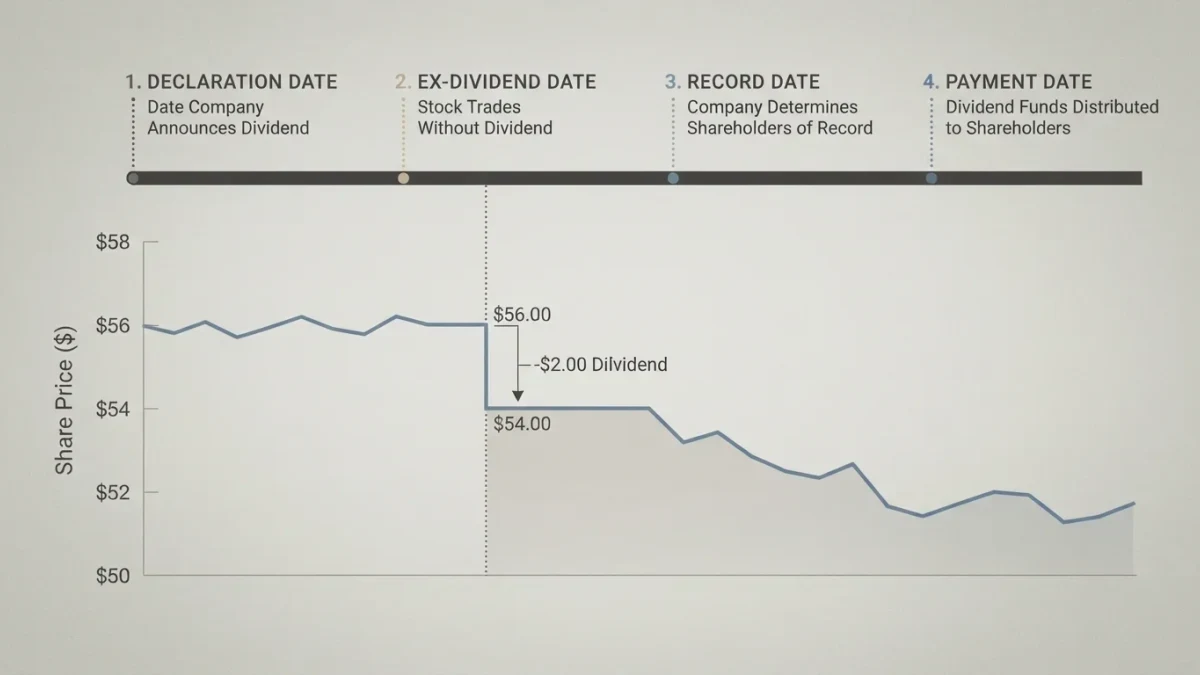
Three dates govern each payout. The ex-dividend date is the cutoff — buy on or after it and you do not receive the coming dividend; the record date fixes who is owed; the payment date delivers cash, typically weeks later. Brokerages offer automatic reinvestment: on payment, the dividend buys fractional shares at the next available price, commission-free. The declaration date, when the board announces the amount, matters for income planning but not for mechanics.
What does reinvestment do to returns?
It converts income into compounding. Consider a hypothetical $10,000 position in a fund yielding 3% with 4% annual price growth. Without reinvestment, after twenty years the price-appreciation value reaches about $21,900 while the dividends — roughly $7,900 assuming a static yield for illustration — sat in cash earning nothing. With dividends reinvested, the same position grows to approximately $26,500, the difference being the shares those dividends bought and the growth and dividends those shares then produced. The gap widens with every additional year, which is the entire point: compounding's curve bends upward at the far end, where most investors quit the illustration.
| After | Price growth only | With dividends reinvested |
|---|---|---|
| 10 years | $14,800 | $16,300 |
| 20 years | $21,900 | $26,500 |
| 30 years | $32,400 | $43,200 |
The table is a hypothetical illustration assuming a constant 4% price return and 3% reinvested yield — real markets deliver neither constantly nor smoothly, and past patterns never guarantee future results.
Why do so few investors capture the full effect?
Because the cash is seductive. Dividends arrive as spendable money at exactly the moment spending is tempting, and each diverted dollar quietly exits the compounding machine. Behavioral research on dividend utilization consistently finds reinvestment rates far below participation rates in dividend-focused strategies. The fix is structural, not motivational: automatic reinvestment set once at the brokerage, converting a monthly temptation into a default that requires effort to break.
Are reinvested dividends taxable?
In taxable accounts, yes — reinvested dividends are taxed in the year received exactly as if taken in cash, and their purchase price becomes cost basis that reduces the eventual capital gain. This is the arithmetic behind dividend-focused tax strategies: qualified dividends currently taxed at preferential rates still create annual tax drag that tax-advantaged accounts avoid entirely. Holding high-yield positions inside IRAs preserves the full compounding curve.
Does reinvestment change portfolio risk?
It tilts the position toward whatever pays the dividends — reinvesting automatically concentrates accumulation in dividend-paying holdings and in down markets buys more of what fell. Over long periods this is simply dollar-cost averaging applied to income, generally favorable; investors running automatic reinvestment should still do the overlap and allocation audit annually, since decades of autopilot can drift a portfolio far from its intended shape.
What changed with modern settlement and payment cycles?
The machinery has tightened over the years: quarterly and monthly dividend schedules remain standard for funds, but settlement moved to one business day for US securities in 2024, and reinvestment now executes within days of payment rather than weeks. The change is small for a single cycle and meaningful across a career — cash sits idle for less time between payment and reinvestment, and the compounding clock loses fewer beats per year. The practical effect for investors is that automatic reinvestment is now nearly frictionless wherever it is offered, removing the last manual excuse between income and compounding.
How do dividend-focused funds change the reinvestment math?
Funds engineered for higher yields reinvest larger distributions, which widens the gap between reinvested and cash-taking outcomes in both directions — the compounding benefit is larger, and so is the sensitivity to the payout's sustainability. A yield achieved by holding deteriorating businesses can compound losses as faithfully as a healthy payout compounds gains, which is why reinvestment strategy and dividend-quality analysis are separate questions. The mechanism is neutral; the inputs decide.
What does the dividend puzzle in the total-return era mean for reinvestment?
Dividend payouts as a share of market value have declined over decades as buybacks took a larger share of corporate payouts — the S&P 500's yield running near 1.5% in recent years against 3% or more in earlier eras — but the compounding logic is unchanged: total payout, dividends plus net buybacks, is what returns cash to shareholders, and reinvestment converts whichever form it takes into future shares. The investor automating dividend reinvestment while ignoring buybacks captures most of the effect, because buybacks work through the share count automatically. The refined version of the habit is simply not to mistake a lower yield for lower payout.
Should reinvestment pause near retirement?
Approaching distribution, the reinvestment default deserves a deliberate review rather than a habit carried forward: retirees spending dividends rationally stop reinvesting them, and the portfolio's income sleeves gradually switch from accumulation mode to paycheck mode. The mechanics of that switch — which accounts distribute first, how withholding is set — are the retirement plan's plumbing, and the year before the first withdrawal is the calm moment to lay them.
What role do reinvested dividends play in bear-market recovery?
Reinvestment's least appreciated work happens in declines: distributions arriving during drawdowns buy shares at prices the same dollars would not touch in calmer markets, quietly accumulating the position the recovery multiplies. The 2009-2013 rebound illustrated the mechanism at scale — reinvesting holders rebuilt balances years ahead of cash-taking peers holding identical funds. The behavior required is nothing more than leaving the default on, which is the strongest argument for automation: the investor who must decide each quarter eventually declines, and the investor who decided once compounds through.
FAQ
Should I reinvest dividends or take the cash?
For portfolios in accumulation with no income need, reinvestment is the evidence-aligned default — the third-of-total-return arithmetic above is why. Investors in distribution, funding spending from the portfolio, rationally take the cash instead.
Do reinvested dividends create a wash sale problem?
They can, when shares of the same security are sold at a loss within the sixty-one-day window while reinvestment buys more — the classic accidental trigger. Pausing automatic reinvestment before a planned loss sale is the standard precaution.
Are dividend reinvestment plans and brokerage reinvestment the same?
Functionally similar today. Classic company DRIPs bought shares direct from the issuer, sometimes at discounts; brokerage automatic reinvestment buys fractional shares on the open market. The compounding mechanics are identical.
Does a high dividend yield make reinvestment better?
Not necessarily — yield is one variable in total return, and high yields often accompany slow growth or elevated risk. The reinvestment mechanism rewards total return, not the payout alone.