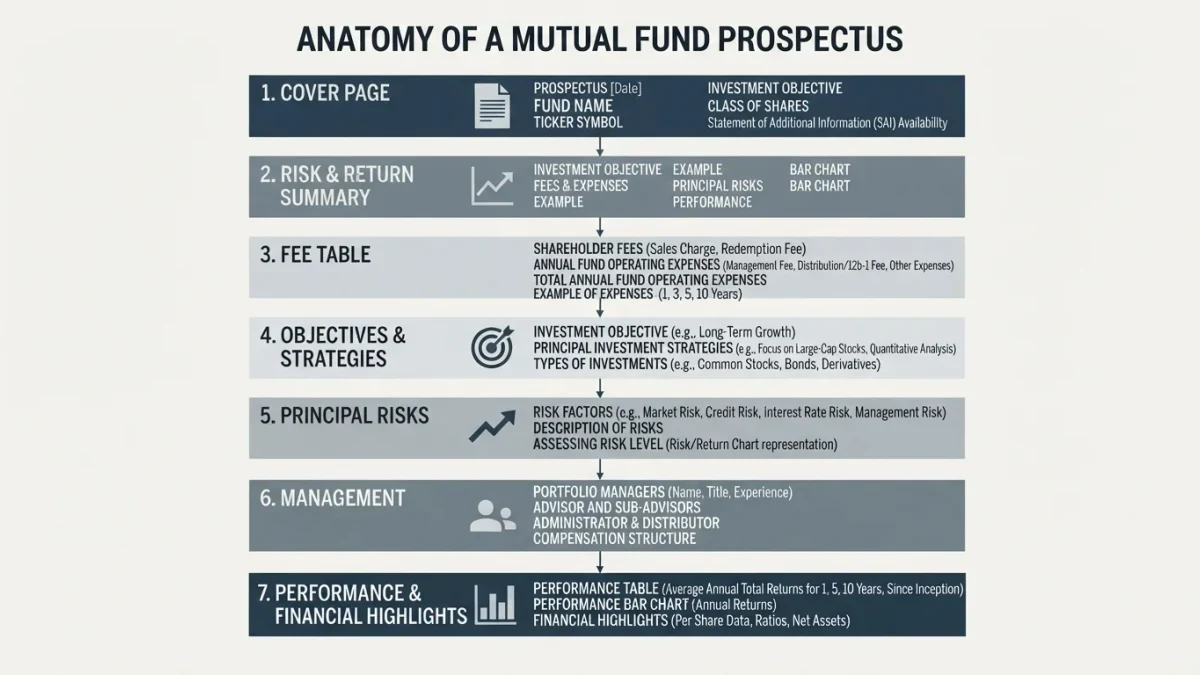
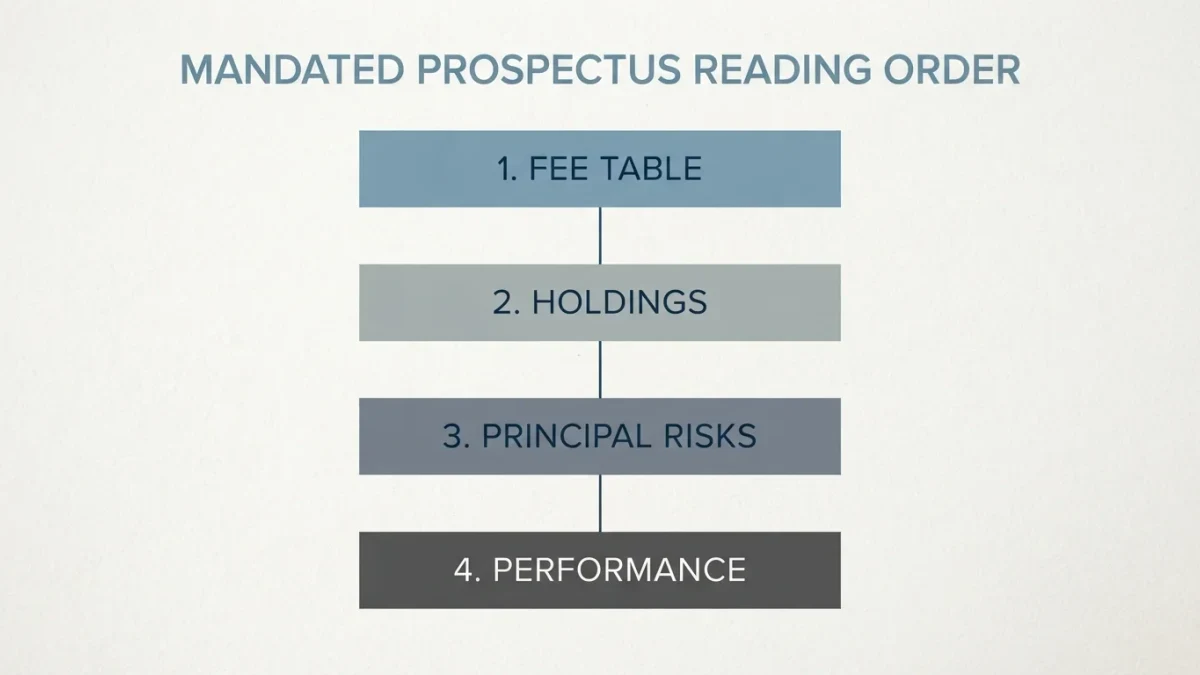
A fund prospectus can be read usefully in twenty minutes because its structure is standardized: the Securities and Exchange Commission requires every US mutual fund and ETF to present its fees, investment strategy, principal risks, and performance history in a mandated order, with a summary prospectus up front condensing the essentials. The document is the fund's own authoritative description of itself — the attributed source of its terms, never evidence of future results.
What are the four sections that matter?
Start with the fee table: total annual fund operating expenses expressed as a percentage of assets, plus any shareholder fees such as loads or redemption charges. Then the holdings snapshot — top ten positions, sector weights, number of holdings — which answers what the fund actually owns. Third, the principal risks, in the fund's own words; and fourth, the performance table, which by regulation shows calendar-year returns and a hypothetical $10,000 growth illustration over stated periods. Everything else in the document supports these four.
How do you read the fee table correctly?
The line to weigh is total annual fund operating expenses — the expense ratio — with a worked example below showing what each percentage costs per $10,000 invested. Watch for the distinction between gross and net expense ratios when fee waivers apply: a waiver is temporary by rule and the net figure can reset to gross when it expires. Shareholder fees outside the table's annual section — front-end loads, exchange fees — matter most for actively traded accounts.
What do the risk disclosures actually tell you?
Principal risks read like boilerplate but encode real information in their order and specificity: the risks listed first are those the manager considers most material, and unusual entries — currency hedging, derivatives, single-country concentration — flag exposures the fund's name may not suggest. The strategy section pairs with it: what the fund may buy, in what ranges, and whether it may use leverage or lending. Reading strategy and risks together answers the practical question of whether the fund does one job or several.
What should the performance table make you do?
Mainly, distrust it. The regulation requires calendar-year bars, which honestly expose the bad years, plus a $10,000 hypothetical growth line and comparisons against a benchmark. The disciplined reading compares the fund against its stated index over the longest period shown — persistent, large tracking differences against the fund's own benchmark reveal either cost drag or strategy drift. Past performance carries the standard warning because it has almost no predictive power over the next period, a finding the SEC itself emphasizes in investor materials.
| Section | Read for | Red flag |
|---|---|---|
| Fee table | Total operating expenses; waivers | Net ratio well below category only via temporary waiver |
| Holdings | Top ten, sectors, count | Holdings contradicting the fund's stated style |
| Principal risks | Order and unusual entries | Leverage, derivatives unnamed in marketing |
| Performance | Benchmark gap, bad-year bars | Cherry-picked periods in narrative text |
Where do you get the real document?
Brokerage fund pages link the current prospectus directly, and EDGAR holds the statutory filings — Form N-1A for US funds — including the full prospectus behind the summary version. The statement of additional information supplements it with complete holdings lists, portfolio turnover, and manager histories for the reader who wants the second hour of depth.
What red flags deserve a second read?
A few patterns justify slowing down. Expense waivers flagged in the fee table mean the headline ratio is temporary — the footnote states the expiry, and the net figure can reset upward. A style that migrated — a fund named value holding growth multiples, or large-cap holdings creeping into a small-cap portfolio — shows in the holdings table, and the drift rarely favors the shareholder. Manager tenure measured in months against a performance record measured in years means the advertised history belongs to someone else. Frequent index changes or share-class creations suggest a sponsor optimizing for marketing rather than tracking. None of these flags is disqualifying alone; each is a question the document itself has raised.
What is in the statement of additional information?
The SAI is the prospectus's appendix and the analyst's shortcut: complete holdings lists with turnover, the full schedule of fees paid to the adviser, portfolio manager histories with compensation structure, and the legal mechanics of lending and derivatives policies. For index funds the SAI is usually short and dull — the highest compliment available — while complex strategies reveal themselves in the same pages. Reading the prospectus answers whether to own the fund; reading the SAI answers how it is actually run, a distinction that matters exactly once per fund and pays for a decade.
How do share classes complicate the fee table?
The same fund often sells through multiple share classes with different fee structures: A shares carry front-end loads, C shares carry higher annual 12b-1 distribution fees, and institutional or advisor classes carry neither for qualifying buyers. The prospectus table presents each class side by side, and the honest comparison holds total cost constant over your expected holding period — loads amortize over years, so a C share can cost more than an A share held a decade, and the reverse held for two. Reading the table for your own holding period, not the class the seller defaults to, is the entire discipline.
How often should you reread it?
Annually is plenty, and most years the reread is a confirmation rather than a discovery. Funds file updated prospectuses each year with refreshed holdings, performance bars, and any fee or strategy changes — the shareholder report arriving at the same time summarizes what moved. The habit worth building is scanning the fee table and the strategy paragraph against the prior year's version; anything unchanged takes a minute, and the rare change is precisely what the review exists to catch.
FAQ
Summary prospectus or full prospectus?
The summary answers most questions — fees, strategy, risks, performance — in a few pages and is the right first read. The full document adds detail required by regulation, and the statement of additional information adds nearly everything else.
How current are prospectus holdings?
Holdings in the prospectus are snapshots as of its date; complete current portfolios appear in the fund's regular shareholder reports filed with the SEC. For overlap checking, the newer filings are the better source.
What does a benchmark tell me?
The benchmark defines the job the fund claims to do. A fund lagging its own index by its expense ratio is doing exactly what an index fund should; large gaps in either direction mean the fund is not running the strategy its benchmark implies.
Do ETFs have prospectuses too?
Yes — the same Form N-1A structure and the same four sections, plus ETF-specific mechanics like creation units described separately. The reading order and the red flags are identical.