Starting with little money is no longer a structural obstacle: major US brokerages open accounts with no minimum and no deposit, fractional shares allow a first position for the price of a coffee, and the asset-weighted average expense ratio for equity index funds was 0.05% a year as of 2023, per the Investment Company Institute's 2024 fact book. What remains is a sequence — emergency buffer, account type, a single broad fund, automation — that this guide walks through. NewsJay publishes information and education, not investment advice, and nothing here recommends any specific fund or account.
What should come before the first investment?
A small cash buffer comes first, because the first job of a small portfolio is to survive long enough to compound. Money invested in stocks should be money with no scheduled job for at least five years; a car repair in month eleven forces selling at whatever price the market offers that week. Even one month of expenses in a high-yield savings account changes the arithmetic, and a starter target of three to six months, built gradually from the same paycheck that funds the investing habit, is the conventional guidance.
Which account type should come first?
For most beginners with earned income, a workplace retirement plan up to any employer match is the first stop, because a match is an immediate return no market can offer. Beyond the match, a Roth IRA shelters decades of growth from tax for people within income limits — $7,000 was the annual contribution limit for those under 50 as of 2025, per the Internal Revenue Service, and the 2026 figure should be confirmed on the IRS retirement pages. A plain taxable brokerage account comes last, offering full flexibility with annual taxes on dividends and realized gains.
What should the first fund look like?
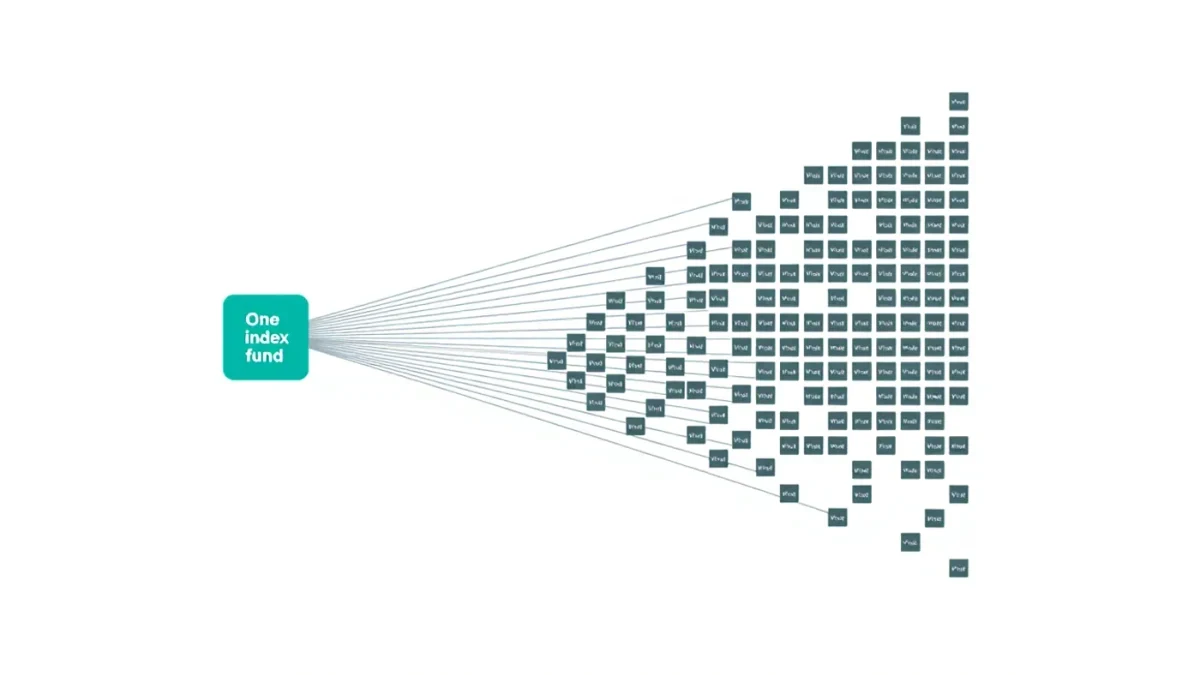
The first holding does the most work if it is broad, cheap, and boring: a total-market or large-cap index fund holding hundreds or thousands of companies, so the beginner owns the market's return instead of one company's story. Diversification in a single fund removes the need to be right early, which is exactly the skill a first-year investor is still building. The checklist is short.
- Expense ratio at or near the index-fund average — every dollar of fee is a dollar not compounding
- Thousands of underlying holdings, not a concentrated theme
- Available commission-free at the investor's own brokerage, ideally supporting fractional shares
- Understandable in one sentence: what market does it track, in what proportion
How does dollar-cost averaging fit a small start?
Automating a fixed monthly amount — $50, $100, whatever survives the budget — converts investing from a decision into a habit and buys shares across high and low months alike. On small balances the long-run advantage is less about price averaging than about removing the timing question entirely: the beginner who invests every month for ten years beats the one waiting to accumulate a sum worth investing. The arithmetic of starting now, with little, dominates the arithmetic of starting later, with more.
What does the first month actually look like?
The steps fit on an index card.
- Open a no-minimum brokerage or IRA account online — identity documents, ten minutes
- Link a checking account and schedule an automatic transfer the day after payday
- Choose one broad-market index fund with a fee near the category average
- Set the transfer to buy automatically, fractional shares if needed
- Turn off price alerts; revisit the account quarterly, not daily
What mistakes cost small investors the most?
The expensive errors at small scale are behavioral rather than mathematical: theme-chasing into whatever rose last quarter, trading on headlines, and stopping contributions during the first bad market — historically the moment future returns were being discounted. Margin and options belong nowhere near a first account. A small, automatic, boring portfolio that survives its owner's first bear market is the victory condition.
What common beginner questions does the evidence answer?
The first year raises predictable questions with durable answers. Timing: the evidence on lump sums says start now rather than waiting for a better moment, because waiting is itself a position — in cash. Selection: one broad fund beats a curated portfolio of five specialty funds, because early mistakes are cheap at small scale but expensive as habits. Monitoring: quarterly statements suffice, and checking daily works against the plan by making noise feel like information. Fees: a fund costing a few hundredths of a percent a year versus one costing a full point is the single easiest improvement available to a small account, worth more than any decision about which market to hold.
How does a small portfolio grow into a real one?
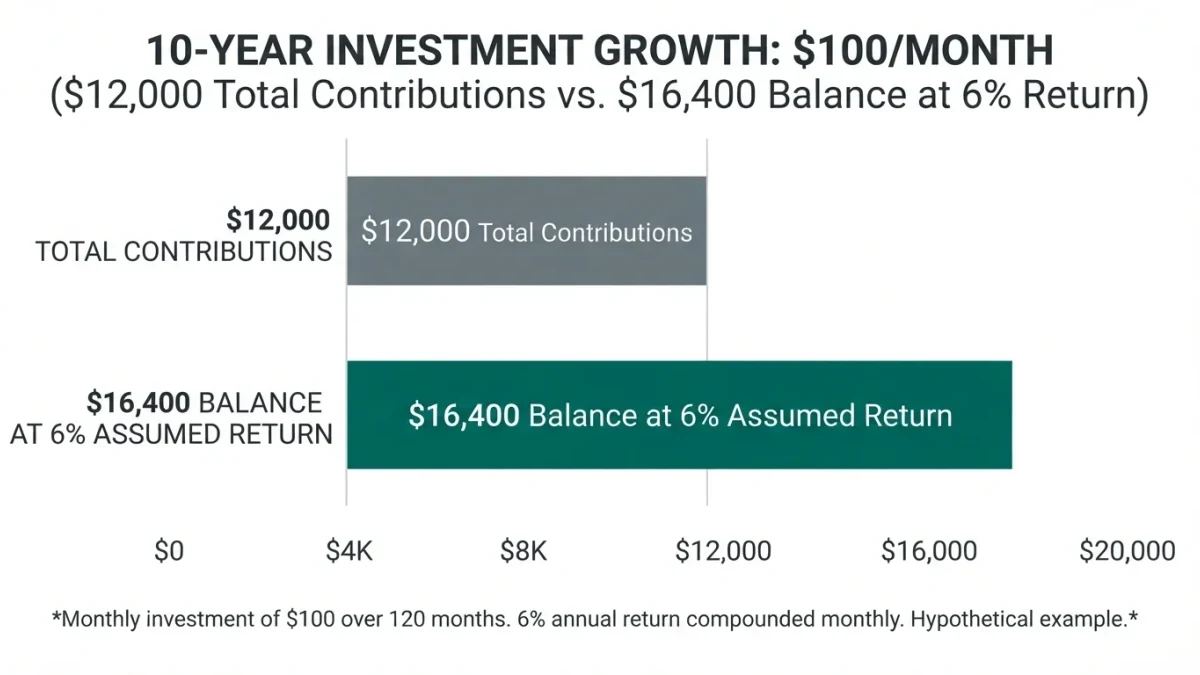
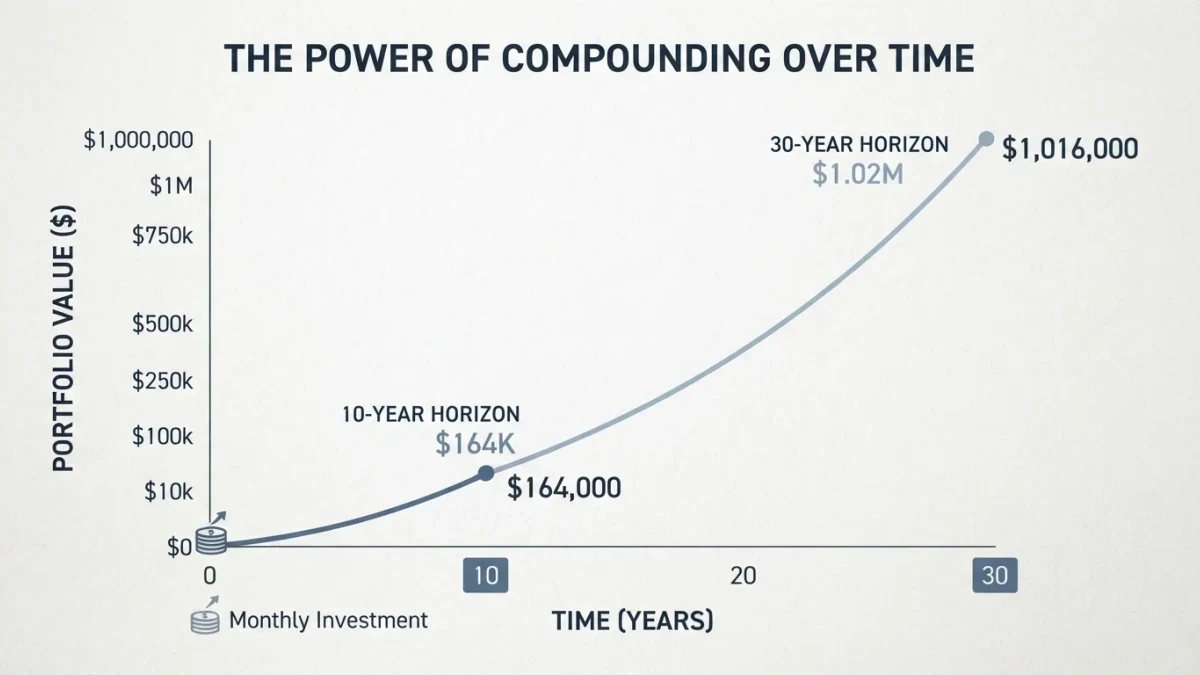
Through contributions first and compounding later — in that order. In the early years, the balance is mostly deposits; a saver adding $100 a month sees market swings move the total by less than the next contribution. The behavioral use of that fact is liberating: while the balance is small, attention belongs on the savings rate and the fee schedule, the two variables fully under the saver's control, because no allocation decision can matter as much while deposits dominate the account. The market's contribution takes over with time, arriving on the same schedule set in the first month.
What role does a savings account play alongside investing?
The savings account is the investing plan's foundation, not its opposite: a cash reserve keeps small market declines from becoming forced sales. For most beginners the sequence is a starter reserve of one month of expenses, then investing, then finishing the reserve in parallel — a schedule that respects both compounding and sleep. High-yield savings accounts at FDIC-insured banks pay meaningfully more than branch accounts, and the difference compounds quietly. The reserve belongs somewhere boring and liquid, sized to the household's real monthly number, and revisited whenever fixed obligations change.
FAQ
Is $50 a month worth investing?
Yes, chiefly because the habit compounds along with the money. Fifty dollars a month for ten years is $6,000 of contributions; at a hypothetical 6% annual return it grows near $8,200, illustrating the mechanism rather than promising an outcome. The behavioral capital built in year one outlasts the starting balance.
Should I save an emergency fund before investing at all?
A modest buffer first — even a month of expenses — then both in parallel is the balanced path for most people. Investing every dollar while carrying credit card debt is the one clearly wrong ordering; high-interest debt compounds against the borrower faster than markets compound for them.
Are fractional shares real ownership?
Yes — a fractional share is an indivisible claim on the same underlying security, typically held through the brokerage's systems. Dividends and price changes apply proportionally. The mechanics differ slightly on transferability between brokers, which matters only when moving accounts.
Do I need to pick several funds to be diversified?
No. One total-market fund is already diversified across hundreds of companies. Additional funds refine exposure — adding international or bonds — but diversification is not the reason to multiply holdings at the start.