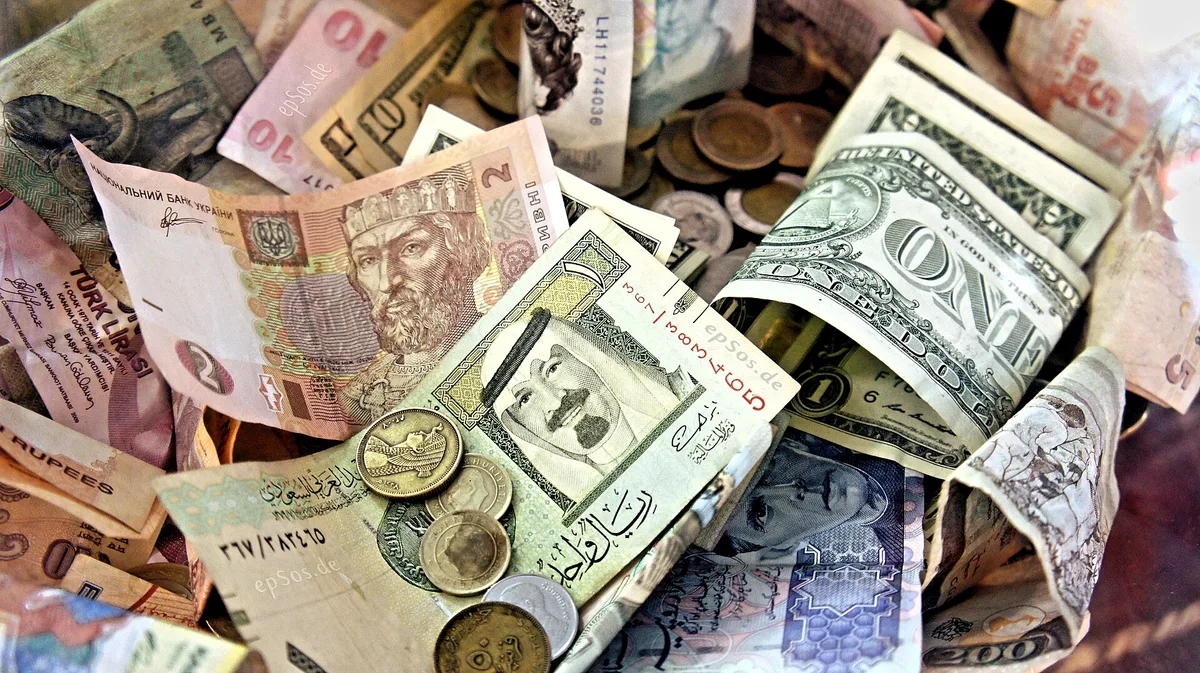
The question starts with the word why, which asks for the cause or intention underlying an action or situation, as Vocabulary.com defines it. The cause here is simple: when you buy a stock listed outside your home country, you own two things at once. You own the company, and you own a position in its currency.
That second ownership is easy to forget. A fund that holds Japanese companies, for example, reports its value in dollars, but the underlying businesses earn yen. If the yen weakens against the dollar, the value of those earnings in dollar terms falls, even if the companies themselves did nothing wrong. Currency risk investing is the practice of understanding and managing that second, hidden position.
This matters to long-term investors because foreign shares are a normal part of a diversified portfolio. The effect of exchange rates is not exotic. It shows up in ordinary statements, quarter after quarter, whether or not anyone notices.
What exactly is currency risk?
Currency risk, sometimes called exchange-rate risk, is the chance that a change in the value of one currency against another will change what your investment is worth to you. It is separate from the risk that the company performs badly. Two different dials move the needle on a foreign holding: how the business does, and what its currency does.
Suppose a European company's share price rises over a year. An American investor's return depends on the euro as well. If the euro strengthens against the dollar, the investor gains twice: once from the stock, once from the currency. If the euro weakens, the currency move can shrink the gain, erase it, or turn it into a loss. The company's performance and the investor's experience can point in opposite directions.
The same logic runs in reverse for foreign investors who own American stocks. This symmetry is worth internalizing. Currency risk is not a penalty attached to foreign investing. It is a fact of any cross-border holding, in either direction.
How do exchange rates change what a foreign stock is worth?
The arithmetic is straightforward. Roughly speaking, a foreign stock's return in your home currency equals the stock's return in its own market, plus or minus the currency's move against your currency. Each part can be large. Each can offset the other. We covered a connected angle in Most Active Large-Cap Funds Still Trail the S&P 500.
Consider the chain of cause and effect. A country's central bank changes interest rates. Higher rates can attract capital, which can strengthen the currency. A stronger currency makes that country's stocks worth more to foreign holders, all else equal. But it can also squeeze the companies themselves, because a strong currency makes their exports more expensive abroad. One policy decision ripples through a port, a factory, an earnings report, and finally a retirement account on another continent.
This is why currency moves often look puzzling in a statement. A holding can fall in its home market and still rise in your account, or the reverse. Neither number is wrong. They are answers to different questions.
It also cuts the other way for the companies you might own domestically. Many large American firms earn a substantial share of their revenue overseas. When the dollar strengthens, translating that foreign revenue into dollars yields less. Currency risk investing, done thoughtfully, includes noticing that even a home-country portfolio carries some exposure through the earnings of multinational businesses. Readers who want the parallel fixed-income effect can see how rate moves hit bonds in our Bond Duration: Why Interest Rate Changes Hit Some Bonds Harder Than Others explainer. For related coverage, see Bond Duration: Why Interest Rate Changes Hit Some Bonds Harder Than Others.
Does hedging remove the problem, and should you bother?
Hedging means using financial contracts, typically currency forwards, to lock in an exchange rate for a period. Some international funds offer hedged share classes that do this for you. The hedge reduces the impact of currency swings on the fund's value in your home currency. It does not make the investment safer in every sense. It trades one kind of uncertainty for another, plus a cost.
Hedging works best, in principle, over shorter horizons and for assets whose returns are relatively stable, because the hedge itself must be rolled repeatedly and each roll has a price that depends on interest-rate differences between the two currencies. Over long horizons, the case is less clear. Some evidence-based approaches argue that currency effects tend to wash out over decades, so paying to hedge them may add cost without adding much. Others prefer hedged exposure for the smoother ride. Both are defensible positions; neither is a guarantee.
What this means in practice: check whether an international fund you hold is hedged or unhedged. The fund's own prospectus or fact sheet states this, and those documents are the attributed source of the fund's terms, not evidence of future results. The distinction is often visible in the share class name, but the document is the authority.
Practical steps for a long-term investor
Our analysis of how this topic usually trips people up points to a short checklist rather than any single rule. This is educational information, not advice to buy or sell anything.
- Find out how much of your stocks and funds exposure sits outside your home currency. Fund documents and brokerage screens usually break this out by region.
- Check whether each international fund is hedged or unhedged, using its prospectus or fact sheet.
- When a foreign holding moves sharply, ask which dial moved: the market, the currency, or both. Brokerage tools that show returns in local currency help here.
- Resist the urge to trade on a currency view. Forecasting exchange rates is notoriously difficult, and a long-term plan should not depend on getting it right.
- Revisit the question when your horizon or your home currency changes, not when headlines do.
The last point deserves emphasis. Currency headlines are loud because exchange rates move every day and every move has a story attached. Most of those stories are noise for someone investing over decades. Our Markets News coverage tries to separate the durable from the daily, and the same discipline applies here. A measured skepticism toward short-term currency forecasting is the house view, stated once and without sermon.
What the evidence establishes, and what it does not
What is well established: foreign holdings carry currency exposure by construction; that exposure changes your returns in home-currency terms; hedging can reduce the swings at a cost; and multinational companies transmit currency effects even into domestic portfolios. None of this requires a forecast to accept.
What remains genuinely uncertain: whether hedging helps or hurts over a multi-decade horizon in any given period, and where any particular currency goes next. Honest writing on this topic ends where the evidence ends. The reasonable takeaway is not to eliminate currency risk, which is rarely possible without cost, but to know how much of it you hold and to let that knowledge, rather than a headline, shape your decisions. For broader context on building a durable plan, our investing hub collects the core explainers.
One final note on the word itself. The Cambridge Dictionary's entry for why frames it as the question of the reason something took place, ideally accounting for all the factors involved. That is the right standard here. Currency effects are one factor among many in a portfolio's results, and the investor who accounts for them is simply seeing the whole picture.