The consumer price index report is best read as four numbers: the headline year-over-year change, the core rate that strips food and energy, the shelter component that lags the rest by design, and the monthly change annualized — roughly 0.17% a month compounds to the Federal Reserve's 2% objective. The Bureau of Labor Statistics samples approximately 80,000 prices monthly across urban consumers, publishing at 8:30 a.m. Eastern on release day. NewsJay publishes information and education, not investment advice, and no single print should move a long-term plan.
Why do headline and core disagree — and which matters?
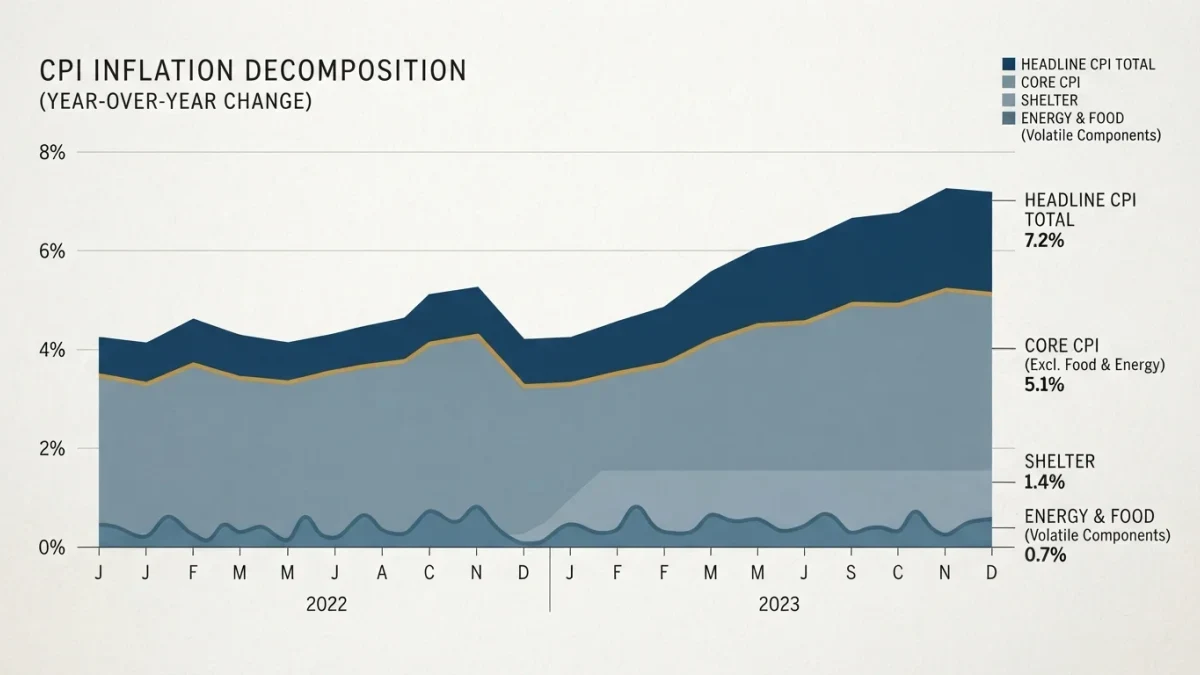
Headline CPI is what households actually pay, which is why Social Security cost-of-living adjustments and some contracts index to it. Core excludes food and energy because those two categories are volatile and mean-reverting — fuel swings reflect supply shocks more than underlying trend. Central banks weight core as the trend signal while acknowledging that consumers live in the headline. When the two diverge for a quarter or more, the gap usually tells the story: energy spikes lift headline over core, as in spring 2026's reacceleration; shelter quirks can do the reverse.
What is the shelter puzzle?
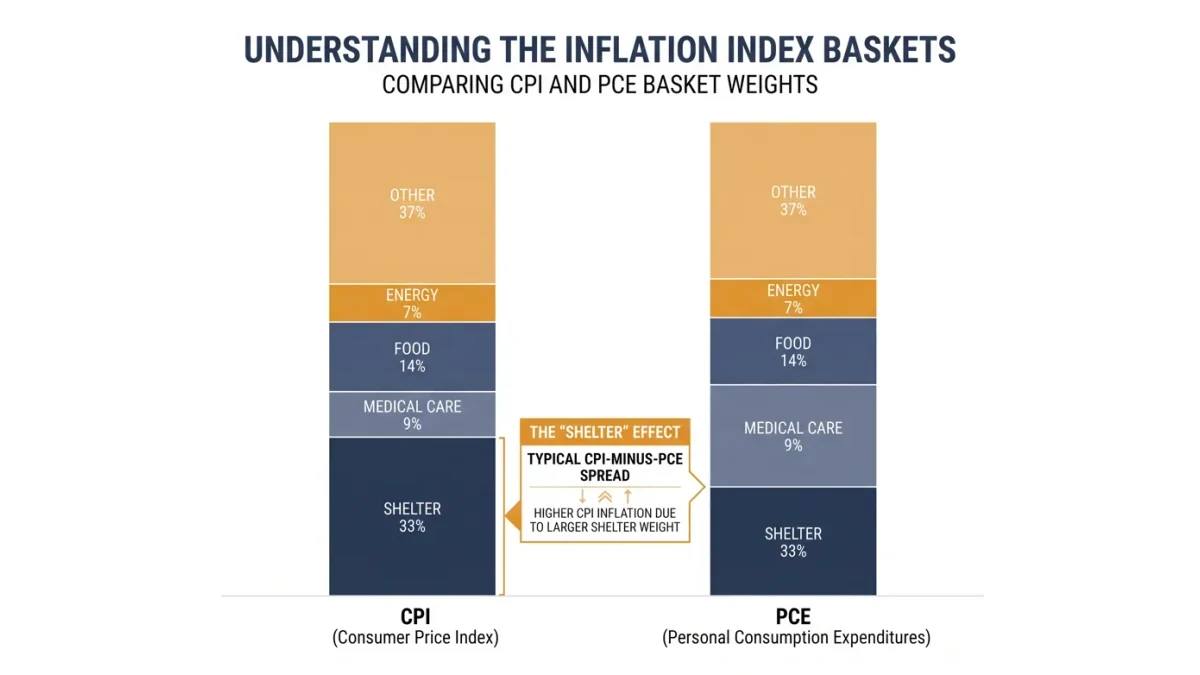
Shelter is about a third of the CPI basket — the largest single component — and its main measure, owners' equivalent rent, moves on an approximate lag behind market rents by many months, because the survey samples existing tenants whose leases reset slowly. The consequence cuts both ways: when market rents surged, CPI shelter kept inflation elevated long after new leases cooled; when rents cooled, the same lag kept measured shelter sticky on the way down. Investors who read market-rent data ahead of the CPI's shelter line are reading the future of roughly a third of the index.
| Number | What it answers | Watch for |
|---|---|---|
| Headline YoY | Cost of living change | Basis effects from prior-year spikes |
| Core YoY | Trend inflation | Central bank's working gauge |
| Shelter | Largest component | Lag distortion versus market rents |
| Monthly, annualized | Current run rate | 0.2% monthly ≈ the 2% pace |
Why do markets react to the surprise, not the level?
Bond and equity prices on release day respond to the gap between the print and consensus expectations — a 3.4% reading expected at 3.6% rallies markets that a 3.4% expected at 3.2% would punish. This is why identical inflation produces opposite market days, and why reading the forecast alongside the release is part of reading the release. For long-horizon investors the practical use of the report is slower: inflation determines real returns on fixed-income holdings and informs how aggressively the Fed can ease, both of which matter at allocation speed, not intraday speed.
What did the 2025-2026 sequence teach?
The period supplied a clean case study: disinflation into January 2026's 2.4% print, then an energy-driven rebound to 3.3% in March — headline volatility around a slower-moving core, with markets repricing the rate path twice in a quarter. The sequence illustrates why single prints mislead and why the Federal Reserve describes itself as watching runs of data: policy reacts to trends the way a thermostat does, with delay by design.
How does the Fed's preferred inflation gauge differ?
The personal consumption expenditures index — released later in each month by the Bureau of Economic Analysis, and the Federal Reserve's stated target measure — differs from CPI in construction: broader coverage, weights that update continuously, and different treatment of housing and medical categories. The PCE has historically run a few tenths cooler than CPI, which is why a 2% PCE world can coexist with CPI prints near 3%. Reading both costs nothing and resolves most of the apparent contradictions between inflation headlines — the two measures are describing the same economy through different lenses, and the disciplined reader knows which lens each claim uses.
What is the one-sentence summary?
Read four numbers — headline, core, shelter, monthly annualized — against expectations and last month, and let runs of prints rather than any single release inform the decisions an allocation actually contains.
FAQ
Is CPI the only inflation measure?
No. The Federal Reserve's preferred gauge is the personal consumption expenditures price index, which weights differently and runs historically cooler; the producer price index feeds pipeline costs forward. CPI's advantage is its component detail and its role in indexed benefits.
Why was shelter so stubborn in recent years?
Methodology: the housing survey reflects existing tenants' slowly resetting rents, so the component lags market rents by many months. The stickiness was measurement lag working through the system, not ongoing rent acceleration.
What is a basis effect?
The arithmetic of comparisons against the prior year: a big spike drops out of the 12-month calculation a year later, mechanically changing the rate without any new price movement. Understanding which base months roll off explains many 'mysterious' headline shifts.
How should retirees use the report?
As a check on withdrawal adequacy: sustained inflation above portfolio returns erodes purchasing power, arguing for inflation-indexed assets in the mix. The monthly print itself justifies no action — the trend across quarters does.