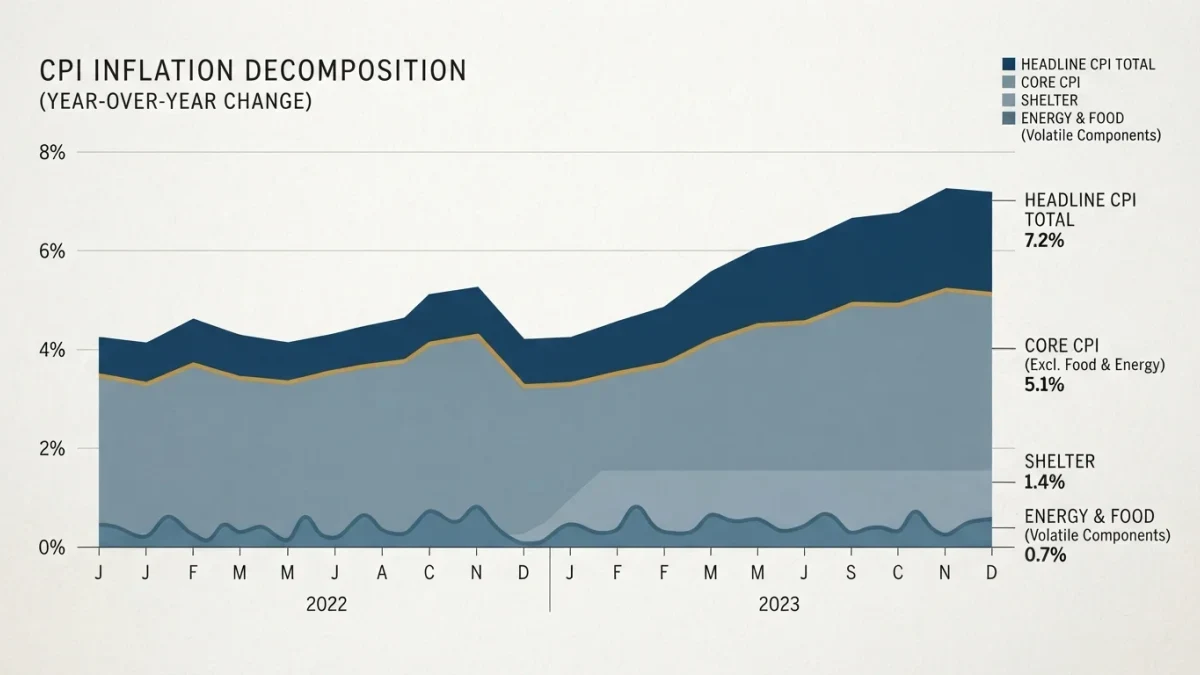

US consumer prices rose 2.4% in the year through January 2026, the Labor Department reported on February 13, below the 2.5% consensus and down from 2.7% in December — the slowest annual pace since May 2025, per CNBC's tally of the Bureau of Labor Statistics release. Monthly prices advanced 0.2%. NewsJay publishes information and education, not investment advice, and no data release changes a decades-long plan by itself.
The print landed as what analysts called a welcome surprise: inflation decelerating even with tariff pressure still working through goods prices, and market commentary shifted toward the odds of the Federal Reserve resuming rate cuts. Bond-market pricing of policy expectations firmed in that direction in the days after the release, per Bloomberg's morning briefs.
What the detail showed
Headline deceleration with a monthly gain of 0.2% from December implies an annualized run rate near the Fed's 2% objective. The slowdown carried through a month in which tariff effects were still present in the economy, which analysts read as evidence that pass-through to consumers had stayed contained. As always, one month is a data point, not a trend: the prior two releases had also moved the conversation, and the February and March prints will test whether January's pace holds.
What a long-term playbook does with a disinflation print
For portfolios measured in decades, the release matters mostly through two channels. Lower inflation supports real returns on bonds, whose coupons are fixed in nominal terms — the reason disinflation is historically kind to high-quality bonds. And cooler inflation expands the Fed's room to cut, which shapes the yield curve's normalization. Neither channel argues for action on the day: the disciplined response is to note the print, check that the portfolio's bond allocation still matches its job, and let the next two releases confirm or refute the trend.
FAQ
Why did markets welcome this report?
Because it beat expectations in the helpful direction: 2.4% versus 2.5% forecast, with the annual pace at its slowest since May 2025. Cooler inflation preserves real income growth and gives the central bank room to ease, both historically supportive for bonds and equities.
Does one CPI report change the Fed's path?
Not by itself. Policymakers weigh runs of data, and single prints get revised. This release strengthened the case for cuts in market commentary; whether that becomes policy depends on the February and March numbers confirming the trend.